Hotels
Hotel phone systems: wake-up calls and the PMS
On this page
- The room phone is a service panel, not a telephone — what should you know?
- Wake-up calls — what should you know?
- Room status, from the room to the PMS — what should you know?
- Call permission by room class — what should you know?
- The night greeting and the front desk — what should you know?
- What to decide before the room list is fixed
The room phone is a service panel, not a telephone — what should you know?
Guests almost never dial a number from a hotel room; they press a labelled key. That is why the hotel phone range in this project is organised around programmable service keys rather than around line counts.
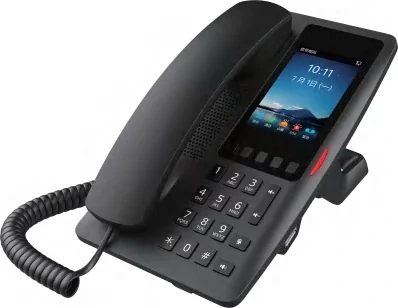
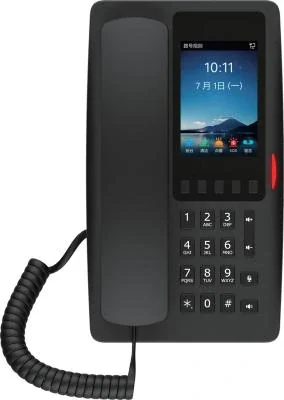
- H6W: five programmable service keys, named in the brochure for housekeeping, ticket booking, the switchboard, ordering food and wake-up call service, with a 3.5-inch screen, integrated PoE, Wi-Fi 6 and a USB-A charging port.
- H602W: six programmable service keys covering the same service list, with faceplate customisation, a magnetic handset, Wi-Fi 6 and a 10/100 Mbps port on DC power.
- H603W: a cordless design with six programmable service dials, a three-colour status light, an antibacterial handset and a fast-charging base; the brochure quotes 8.1 hours of talk time and 159 hours of standby as lab data.
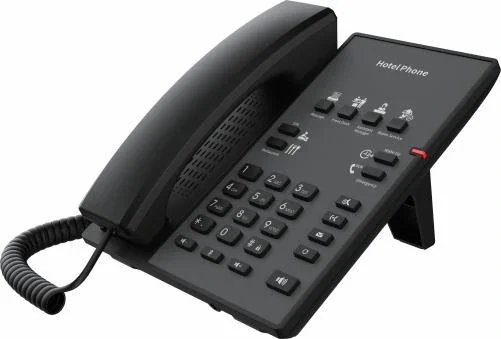
- H2U: ten speed-dial keys for service hotlines plus one programmable key that can be set to work with a door phone for remote door control, in three colours.
Because the labels are programmable, the property decides what each key dials. A spa, a car park or a conference desk is one more label, not one more phone.
Wake-up calls — what should you know?
Wake-up calls are a system feature of the OM series rather than an add-on box, and the voice-prompt set includes a file named wakeup. On the room side the practical implication is that the wake-up key on a guest phone is just another programmable key that dials into the hotel service, and the property's own front-office software drives the schedule.
The material states the hotel management module and the PBX API as the integration route: with the API enabled, the hotel module covers room status and call permission control. It does not describe the front-office screens behind those functions, so the exact workflow is confirmed against the property's system on the quotation - that is an honest boundary rather than a design compromise.
Room status, from the room to the PMS — what should you know?
Room status on this platform starts with a feature code dialled from the room extension. The PBX then pushes the status to the hotel PMS over the API. Three consequences follow for the network designer:
- Housekeeping status can be set from the room handset, so no separate wall panel is required.
- The PMS link is data, not voice, so it needs a route between the PBX and the property management server - not a port in the guest room.
- The PBX API is the same interface used by the call-accounting and operator-assistant applications, so if the property already runs one of those, the API is already switched on.
Call permission by room class — what should you know?
Outbound permissions are set per extension in five levels: internal only, local, domestic (the default), international and barred. On top of that, call barring can restrict extensions or lines by weekday and time band, and an extension lock stops outgoing calls from the handset entirely until it is released.
| Room class | Practical permission |
|---|---|
| Standard room | Domestic, with international barred and the lock applied on check-out |
| Suite or long-stay | International allowed, or released against an authorization code |
| Back office | International allowed, no lock, recorded if the property records calls |
| Public areas | Internal and local only, with the phone locked outside service hours |
An authorization code can also be required for external calls, using the same PIN that unlocks the handset, and calls from outside extensions can be blocked from dialling out at all. For a property that has been burned by a phone left off the hook, these are the settings that matter more than the room tariff.
The night greeting and the front desk — what should you know?
The auto attendant switches between a working-hours and an off-hours greeting, with up to three periods a day defined in the schedule. A hotel can therefore have a daytime menu, a night menu and a weekend menu without touching the equipment.
The operator position answers on extension 200 by default and can carry up to five numbers, distributing calls sequentially, by rotation or to all of them at once. If nobody dials, calls fall to the operator after 24 seconds, and the ring group queue holds up to 20 waiting calls with a prompt for the caller. For the night shift this is the difference between a call being answered by whoever is on reception and a call being lost.
One design note that affects the bill of materials: recording. This platform records in G.711 and G.729, and local on-box recording exists only on the OM20G and OM50G. A larger property that records calls records to a server, and the recording server address and port - 1311 by default - have to be part of the network plan. Call detail records can similarly be pushed to an external server, on port 1809 by default, which is what a call-accounting system consumes.
What to decide before the room list is fixed
- Which room classes get a screen phone and which get a key phone. The H6W's screen and AP mode suit a room where the guest also needs a network link; the H2U's ten keys suit a bathroom or a second position.
- Whether the property wants a phone per bathroom. It doubles the room-side extension count, and it should be a decision, not an accident.
- Which extensions may dial internationally, and whether an authorization code is required after hours.
- Where recordings and call detail records live, because that determines whether the property needs on-box recording on a smaller PBX or a server on a larger one.
Answer those four and the room phones, the PBX model and the trunk count all follow from published capacities rather than from habit.