
Technical Support
Support From the Extension Plan to the First Call
A PBX order is easy to place and harder to configure: extension plans, trunks, analog ports, provisioning and wiring all have to agree before the first call connects. This page describes the support that genuinely exists — planning before the order, guidance while the site is wired, and technical help by email after it — and the parts that are stated on the quotation instead.
- Extension and trunk planning before the order
- Wiring and provisioning guidance
- Documentation supplied with the order
- Post-sales assistance by email
What support covers
Six things we work through with you
Each of these is answered from the product documentation for the models concerned — where a figure is not documented, the answer says so rather than estimating.
Extension planning
Send the room or desk list and we return an extension plan: numbering from the documented default of 200 upwards, departments, ring groups, pickup groups and — where the model supports it — DID mappings that bind an outside number to an extension.
Trunk and line sizing
The published capacity is stated in SIP trunks: 24 on the OM20G, 62 on the OM50G, 216 on the OM80E, 496 on the OM200G and 1000 on the OM1000-UC, each carrying up to 120 concurrent calls (200 on the OM1000-UC). We size the trunks and the analog ports against your call profile.
Endpoint and area counts
How many desk phones, hotel handsets, wireless handsets, intercom stations and paging endpoints each area needs — counted per room, per desk or per entrance, so the bill of materials matches the building rather than the other way round.
Wiring and provisioning guidance
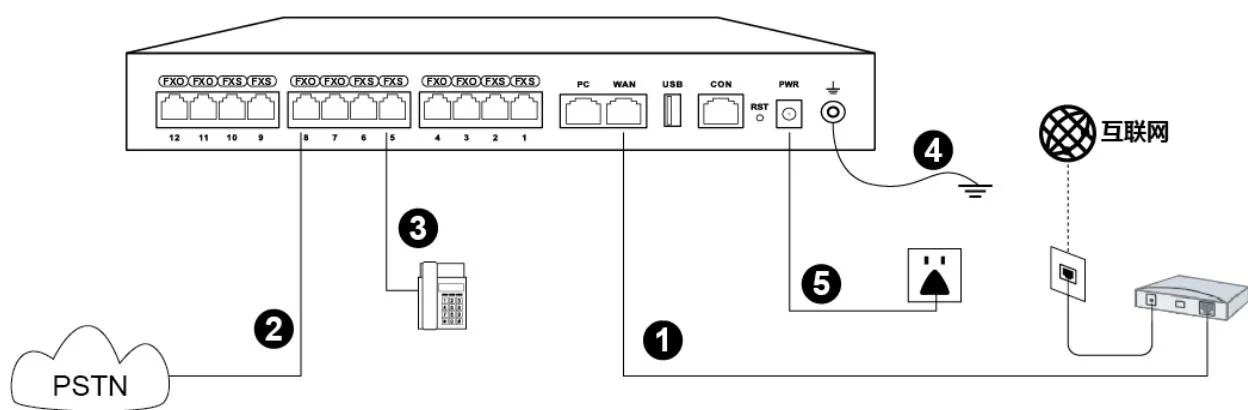
Which cable goes where: RJ45 voice ports broken out to telephone pairs, the console cable for local access, and the network side of the design. Provisioning uses auto-provisioning over DHCP option 66 or TR069 central provisioning where the model documents it.
Documentation with the order
The datasheets, specification tables, wiring diagrams and the manual information available for the models supplied are sent with the quotation and the order, so the installer works from a document rather than from memory.
Post-sales technical assistance by email
Configuration questions after delivery — extension behaviour, trunk registration, auto-provisioning profiles, voice prompts — go to the same team that quoted the order, by email, with the model and the order reference.
The boundary
What is offered, and what is stated elsewhere
Support that is described vaguely is not support. These are the exact commitments on this site:
Pre-sales configuration help
Extension plans, trunk and line sizing, endpoint counts, wiring and provisioning guidance — provided with a project inquiry at no charge.
Post-sales assistance by email
Technical questions about the equipment supplied are handled by email against the model and the order reference.
Installation and on-site work
Installation, cabling, containment and power works on site are carried out by you or your contractor. This website does not offer site attendance as a standard service.
No SLA or response-time guarantee
We do not publish a service-level agreement or a guaranteed response time. The inquiry form asks for the site details that make a reply useful; urgent, site-stopped questions should say so in the subject line.
Warranty terms come with the quotation
Every quotation carries the warranty and after-sales terms for the models and quantity in that order, so you have them before you decide. Spare parts are handled against the original order reference; there is no separate published spares programme.
No certification advice
Where a market requires type approval or a certificate, tell us the destination country and the document required, and the documentation available for the models proposed is checked in writing before the order.
Where to look first
Most technical questions are already answered on this site — the planner does the arithmetic, the knowledge base explains the design decisions, and the FAQ collects the answers published on the product pages.
System planner
Size the model, the SIP trunks and the analog ports from your own numbers before asking for a quotation.
Knowledge base
Guides on how the systems are planned, wired and configured, written from the product documentation.
FAQ
The questions asked most often during sizing and configuration, with the answers published on the product pages.
Contact
Send the site details, a drawing or a model list — the reply is a configuration and a quotation, not a questionnaire.
Sending a technical question
A useful question contains four things: the model, what the system is doing instead of what you expect, the configuration screen or setting involved, and the site context — how many extensions, which lines, what the network looks like. Write to sales@ipphonefactory.com or use the form below and the answer comes back against the order reference.
Technical support — questions
Do you help with the design before we place an order?
How is the PBX sized if the product documentation does not publish a maximum extension count?
Can you help while an installer is on site?
Where do the wiring and provisioning details come from?
Is support the same as a warranty?
Talk to technical support
Building type, room or desk count, areas to cover and the lines you already have. The reply is a configuration, a quotation and — where it matters — the wiring and provisioning notes for the installer.
Send the site details
Six facts build a configuration: site type, extensions or rooms, simultaneous calls, areas to cover, existing lines and the documents you already hold. Send as many as you know — nothing has to be final before the first reply.
- Reply within one working day
- Configuration + quotation for your site
- Your details are used only to answer this inquiry
Page author: NEXVIA EngineeringPublished: Last updated: