Skip to content

Scenarios · parking and vehicle access

Parking Intercom Systems — help points, barrier release and car-park paging on one SIP system

A car park is an unattended space with vehicles in it, which makes it an intercom problem before it is anything else: someone at a barrier needs to reach a person, someone on a level needs to ask for help, and the operator needs to see who is at the entry without leaving the desk. The design on this page builds that from outdoor intercom stations, call points in stairwells and lift lobbies, speakers for car-park announcements and a console for the operator — all registered as SIP extensions on the same PBX as the site telephones. Parking is named as an environment in the paging and intercom material, and car parks appear in the unattended-site list. NEXVIA designs, manufactures, supplies and commissions the system; the terminals are manufactured by NEXVIA.

  • Help points that survive the position: A12V is IP66 and IK10 from −40 °C to 70 °C, with an anti-tamper alarm reported to the control centre
  • Barrier and shutter release as relay contacts — 2 short-circuit outputs on the A12V, one relay on the A10W, one built-in relay on the PA2S gateway
  • Camera on the call: the A12V carries a 4 MP camera with IR night vision and the A513W combines a 4 MP IR camera with an IP66 speaker
  • Car-park announcements on a 30 W IP66 horn (A233) with up to 20 multicast zones with prioritisation
  • One-key alarm activation, alarm light flashing and simultaneous calling to the management unit are stated for the IP endpoint tier
  • Patrol and ground staff on Wi-Fi 6 handsets, or on their existing UHF radios through the W712 gateway
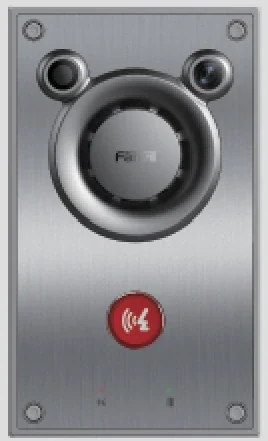
Outdoor video intercom station used at a car-park barrier or vehicle entry point

The short answer

Count the positions a driver or a pedestrian can be stranded at. A single-surface car park lands at 1 to 2 barrier points and 2 to 4 help points in stairwells or lift lobbies; a multi-storey car park typically runs 2 to 4 barrier stations, 6 to 12 help points and 1 operator console — 10 to 18 devices on one PBX with 24 to 496 SIP trunks behind them.

The two numbers that decide the hardware are protection and distance. The A12V is published at IP66 and IK10 with a temperature range of −40 °C to 70 °C, a 4 MP camera with IR night vision, a 10W speaker with echo cancellation and 2 short-circuit inputs and 2 outputs — enough to speak to a driver and release the barrier in the same call. Where only two-core cable reaches a column or a barrier island, the PN1 converter carries network and power over the existing pair, up to 1600 m for the network function without power, and the PN8 and PN24 switches distribute up to 8 and up to 24 devices at a maximum connection distance of 300 m for network plus power.

Announcements and alarms are part of the same design. The A233 is an IP66 horn with 30 W rated output for a surface car park, the speaker family supports up to 20 multicast zones with prioritisation, and one-key alarm activation, alarm light flashing and simultaneous calling to the management unit are stated for the IP endpoint tier. Prices are not published on this site — every car park is quoted per barrier count, help-point count and cable route.

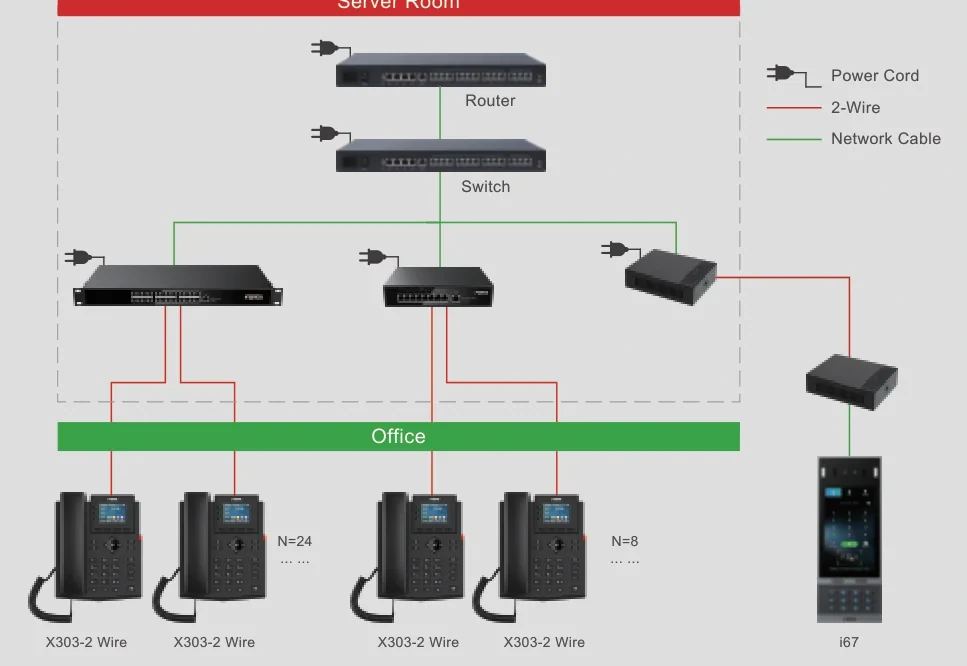
Two-core topology: network and power carried over the cabling already in the wall

What goes wrong on this type of site

The driver cannot open the window

A barrier call happens from inside a vehicle, in the rain, with the engine running. A 10W speaker with echo cancellation and a camera on the station are what make the conversation short; the relay output is what makes it unnecessary to send anyone out.

One level, no staff, no signal

Lower levels are often outside mobile coverage, so a help point is the only way out of a problem. Help points on every level, wired to a help-point call group with a queue of up to 20 waiting calls, keep the position answerable.

The intercom has to survive the site

Exhaust fumes, road salt, jet washing, vehicle impact and winter temperatures of −40 °C are published operating conditions for the outdoor range, not marketing language. Match the rating to the position rather than the position to the model.

Barrier, camera and speaker are three contracts

The barrier is installed by one contractor, the cameras by another and the intercom by a third. The relay contacts, the ONVIF link and the speaker zones are the three interfaces where those contracts meet, so they should be drawn on one sheet before any of them starts.

Choosing by size

Size bandSystemDevicesNotes
Surface car park, single entry — up to 60 baysOM20G — 24 SIP trunks; 4 analog ports if a legacy gate line is kept1–2 barrier stations (A12V / i60K), 2–4 help points (A10W / i16S), 2–4 speakers (A233 outdoors, A212 indoors), 2–4 handsetsThe desktop chassis covers a single kiosk or gatehouse; the OM20G is also the only model that can dial out through a 3G/4G USB modem, which matters at a remote site with no wired line.
Multi-storey car park — 200 to 600 bays, 4 to 6 levelsOM50G — 62 SIP trunks; up to 12 analog ports across 3 interface cards2–4 barrier stations, 6–12 help points across stairwells and lift lobbies, 1 operator console (X210i / A330i), zoned speakers per levelRing groups hold up to 40 extensions on this model, so a help-point group can ring the control room, the gatehouse and a handset without including the whole site.
Car park within a larger building or campusOM200G — 496 SIP trunks; up to 96 analog ports on 24-line interface cardsThe car-park positions above plus the building entrance stations and lift lobbies, all in one dial plan, with an EC20 where lift or floor access is controlled4 hot-swap slots and gigabit Ethernet; the car park shares the PBX with the building, so the operator console answers doors, help points and the lift from one desk.
Multi-site parking operator, several car parksOM1000-UC — 1000 SIP trunks, up to 200 concurrent calls per trunkThe per-site counts repeated, a central monitoring position with DID numbers per site where required, one shared dial planSIP only, with dual hot standby (3 fixed IP addresses) and multi-site networking. A central control room can answer for several car parks without a PBX per site.
Retrofit where only two-core cable reaches the columnOM50G — 62 SIP trunksNew stations at the barrier island and the level help points, with PN1 converters per point and PN8 or PN24 switches per electrical cabinetPN1 carries network and power over a two-core pair with an external AC 100–240 V supply, up to 1600 m for the network function without power; PN8 and PN24 carry 8 and 24 devices at up to 300 m for network plus power.

Numbers behind the design

Parking and vehicle-entry equipment, as published
ModelWhere it goesPublished capabilityProtection and contacts
A12VBarrier island, entry and exit lanes4 MP camera with IR night vision; 10W speaker with echo cancellation; 1 access-control relay; 2 short-circuit inputs and 2 outputs; anti-tamper alarm to the control centreIP66 and IK10, −40 °C to 70 °C; ONVIF and RTSP on the video model; wall and flush mounted
A11 / A11VService yard, staff car park, pedestrian side gateA11V: 4 MP camera with IR night vision; 5W speaker with AEC; 1 access-control relay; 2 short-circuit inputs and 1 outputIP66 and IK10, −40 °C to 70 °C; anti-tamper alarm to the control centre
i16S / i16SVLevel help points, stairwell and lift lobbyi16SV: HD camera with IR night vision, 1080p; 3W speaker with AEC; 2 short-circuit inputs and 2 outputs; 1 access control on the standard models and 2 on the -02P variantsIP65 and IK10, −30 °C to 60 °C; anti-tamper alarm to the control centre
i10S / i10SVSheltered position with a single contact1W speaker with AEC; G.722 and Opus; 1 short-circuit input and 1 output−20 °C to 50 °C; intercom and call point duties where one contact is enough
A10WPedestrian help point, stairwell, plant roomThree function keys; 2W speaker with echo cancellation; one alarm input for an external emergency button; one-click call rings the host plus the call-group extensionsStandard 86 box; PoE or 12 V DC; IP54; −10 °C to 50 °C
i60 / i60KCompact pedestrian columnIC card, PIN (i60K), BLE unlocking, DTMF and app entry; 2 MP camera with IR night vision; 1W speaker with AEC; 1 relay, 1 short-circuit in and 1 outIP65 with the rain cover; 12 V DC or PoE
A513WUnattended level or ramp with a camera positionAll-in-one SIP speaker with a built-in 4 MP HD camera with IR night vision, built-in microphones, dual-band 2.4G/5G Wi-Fi and BLE; relay in and out for a PIR sensor, infrared sensor or strobe lightIP66; PoE or DC; up to 10 W (DC supply)
A233Surface car park and ramp announcementsHorn speaker with 30 W rated output and a built-in microphone for system self-test, monitoring, environmental noise detection and two-way voice; up to 20 multicast zones with prioritisationIP66; PoE, PoE+ or DC
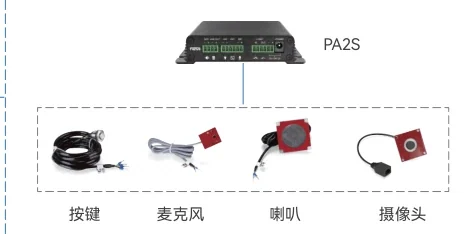
PA2S / PA3Bridging an existing speaker line in the car parkSIP paging gateways with a 10–30 W mono output that adapts to the input voltage, a line out for an external amplifier, an SOS call key, and a built-in relay on the PA2S with 1 short-circuit in and 1 outPA2S: PoE to IEEE 802.3af or 12–24 V 2 A DC, −30 °C to 60 °C. PA3: PoE/PoE+ (IEEE 802.3at, PoE Class 4) or 12–24 V 2 A DC, −20 °C to 50 °C
A330i / X210iControl room and kiosk positionA330i: 10.1-inch touchscreen, 116 DSS keys, 92 dB speaker, 8 short-circuit inputs, 1 output and 1 RS-485 interface. X210i: 106 DSS keys across three screens with a gooseneck microphoneDual Gigabit ports with integrated PoE; group broadcasting from the desk; terminals used with the console are scanned and provisioned automatically
W712Patrol and ground staff on existing radiosRoIP gateway with a UHF 400–470 MHz radio module; one analog or DMR II radio plus one SIP call; group calls between radios and SIP phones; recording to TF card up to 128 GBNetwork plus UHF radio; SIP standard protocol; web deployment and management
This design against a standalone barrier intercom and a separate alarm system
RequirementStandalone barrier intercom and separate alarm systemThis IP designWhat changes operationally
What the barrier call can doTalk only, on a dedicated pair to a kioskA SIP call with a relay action at the station or the console: 2 short-circuit outputs on the A12V, one relay on the A10W, a built-in relay on the PA2SThe operator speaks and releases without a second control
CoverageOne intercom per barrier, nothing on the levelsBarrier stations, help points on each level, stairwell and lift-lobby positions, all as extensions in one help-point groupA stranded driver or pedestrian reaches a person from any level
Video and identityNot available, or a separate CCTV channelA 4 MP IR camera on the A12V, a 4 MP camera plus microphone on the A513W, and ONVIF linkage so the call and its camera can be viewed on a VMSThe operator sees who is at the barrier before releasing it
AnnouncementsA separate amplifier with a local microphone in the kioskA233 horns and zoned speakers on the same system: up to 20 multicast zones with prioritisation, scheduled messages and text-to-speech in the advanced tierThe whole car park or one level can be addressed from the console
AlarmsA pull cord or a push button wired to a bellOne-key alarm activation, alarm light flashing and simultaneous calling to the management unit; short-circuit inputs take alarm buttons and sensors, with relay in and out on the A513W for a strobe lightThe alarm and the call arrive at the same place
RecordsNoneAudio archiving of SIP paging, intercom and calls where the paging tier provides it; call detail records to a server on port 1809; radio and SIP call recording on the W712An incident can be reviewed rather than described
Patrol and ground staffA separate radio networkWi-Fi 6 handsets on the same extensions, or the W712 gateway putting the existing UHF radios on the system with group calls to SIP phonesOne number reaches a person, not a place

Deployment by area

AreaDeviceNote
Barrier island, entry and exit lanesA12V outdoor video intercomIP66 and IK10 from −40 °C to 70 °C with a 4 MP camera with IR night vision, a 10W speaker with echo cancellation, an access-control relay, 2 short-circuit inputs and 2 outputs, and an anti-tamper alarm to the control centre.
Level help points and stairwellsi16S / i16SV intercom (i10S / i10SV for a sheltered single-contact position)i16SV: HD camera with IR night vision at 1080p, a 3W speaker with AEC and 2 in / 2 out at IP65 and IK10 from −30 °C to 60 °C. i10S covers a sheltered position with a 1W speaker and 1 in / 1 out.
Pedestrian help point and lift lobbyA10W SIP mini intercomStandard 86 box with three function keys, a 2W speaker with echo cancellation, one relay and one alarm input for an external emergency button; one-click call rings the host plus the call group.
Compact pedestrian columni60 / i60KIP65 with the rain cover, IC card, PIN (i60K), BLE unlocking, DTMF and app entry, a 2 MP camera with IR night vision, a 1W speaker with AEC and one relay; 12 V DC or PoE.
Unattended level with a camera positionA513W video speakerIP66 all-in-one SIP speaker with a built-in 4 MP HD camera with IR night vision, built-in microphones, dual-band 2.4G/5G Wi-Fi and BLE, relay in and out for a PIR sensor, infrared sensor or strobe light, and up to 10 W on a DC supply.
Surface car park, ramp and entrance announcementsA233 horn speaker, with A212 wall or A201 ceiling speakers on enclosed levelsA233: IP66 horn with 30 W rated output and a built-in microphone for self-test, monitoring, environmental noise detection and two-way voice. A212 publishes 8 Ω with up to 15 W class D and talkback (PoE 8 W / PoE+ 15 W); the A201 rated output is printed two ways in the source, so its wattage is confirmed on the quotation.
Control room, kiosk and patrol staffA330i or X210i console, with W611W / W620W handsets or a W712 radio gatewayA330i: 116 DSS keys, 92 dB speaker and 8 short-circuit inputs, 1 output and an RS-485 interface. X210i: 106 DSS keys across three screens with a gooseneck microphone. Handsets are Wi-Fi 6 with 16 DSS keys and a push-to-talk key; the W712 puts existing UHF radios on the same system.

Questions buyers ask

How many help points does a car park need?

One for every place a person can be stranded without a phone: each barrier, each pedestrian route, each stairwell, each lift lobby and the far end of each level. A multi-storey car park typically lands at 6 to 12 help points plus 2 to 4 barrier stations.

  • Barrier islands take the outdoor-rated stations: the A12V is IP66 and IK10 from −40 °C to 70 °C with a 4 MP camera and 2 in / 2 out.
  • Level and stairwell positions take the IP65 i16S/i16SV with 1080p video, a 3W speaker and 2 in / 2 out where the position is exposed.
  • Pedestrian and indoor positions take the A10W in a standard 86 box with one alarm input for an external emergency button.

Can the intercom release the barrier?

The stations carry the contacts for it: the A12V has 2 short-circuit outputs, the A10W has one relay and the PA2S gateway has a built-in relay with 1 short-circuit in and 1 out. The release itself is wired by the site own barrier or gate contractor.

  • The console can also carry the release where the control room owns it: the A330i has 8 short-circuit inputs, 1 output and an RS-485 interface.
  • Keep the relay logic documented: which station releases which barrier, and what happens when the network is down.
  • Fail-open or fail-closed behaviour of the barrier is a site decision made with the barrier contractor and the fire or traffic authority, not a product setting.

Can the operator see the driver at the barrier?

Yes. The A12V carries a 4 MP camera with infrared night vision, the A513W combines a 4 MP IR camera with an IP66 speaker, and terminals are stated as compatible with SIP and ONVIF — so the call can be linked to a camera and reviewed on a VMS where the site runs surveillance.

  • Video-capable door phones publish H.264, and the indoor stations and guard stations integrate IP cameras for monitoring.
  • Where the site already runs a VMS, ONVIF is the interface to bring the intercom call and its camera into the same view.
  • AI camera events such as intrusion or loitering can trigger pre-recorded broadcasts on the endpoint tier, per the published material.

How do we page a whole car park, or one level?

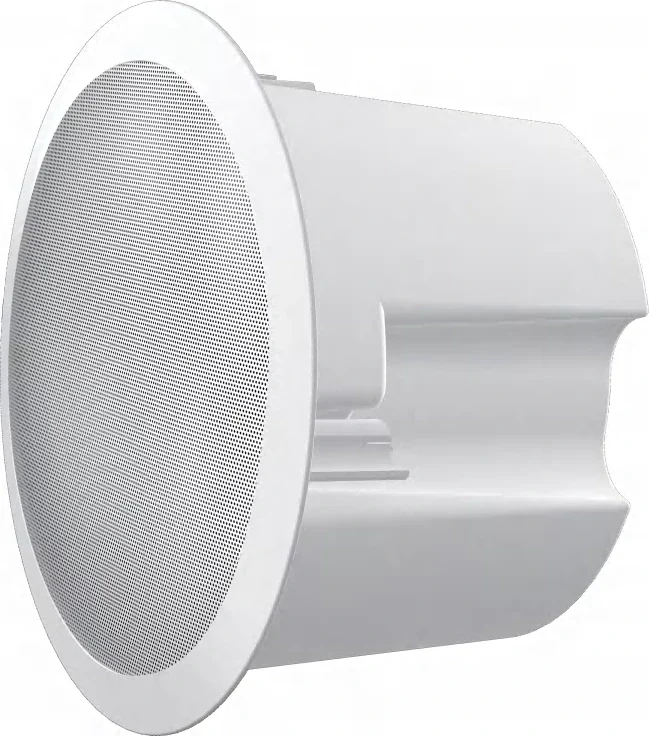
With zoned speakers and horns on the same system. The A233 is an IP66 horn with 30 W rated output for the surface areas, the A212 wall speaker and A201 ceiling speaker cover enclosed levels, and the family supports up to 20 multicast zones with prioritisation.

  • Zones are addressed from the console or an IP phone; the advanced tier adds dynamic zone control and remote volume adjustment.
  • Scheduled broadcasting with custom time templates and real-time text-to-speech are published for routine messages.
  • Where the car park keeps its existing amplifier and speaker line, the PA3 and PA2S gateways drive passive speakers with a 10–30 W mono output and a line out for an external amplifier.

What happens when nobody is in the kiosk?

The call follows the same rules as any other call on the PBX. It can ring a group rather than one position, and it can be routed on to a duty phone, a handset or an out-of-hours number, with time-of-day routing in up to 3 periods per day.

  • Ring groups distribute calls sequentially, in rotation or simultaneously, and up to 20 calls can wait in a queue with a prompt.
  • Ground staff can carry the call on a Wi-Fi 6 handset with 16 DSS keys and a push-to-talk key, or on their existing radio through the W712 gateway.
  • Where the car park is truly unattended, the site should design an out-of-hours destination explicitly — an unanswered help point is a failed design.

What about the pedestrians who use the stairs?

Stairwells and lift lobbies get their own help points, because that is where a person without a car is most likely to be alone. The i16S/i16SV covers an exposed position at IP65 and IK10 from −30 °C to 60 °C with a 3W speaker, a camera on the video model and 2 short-circuit inputs and 2 outputs.

  • The A10W covers a sheltered stair lobby from a standard 86 box with one alarm input for an external emergency button.
  • Lift lobbies can also take a speaker so an announcement reaches the queue at the lift.
  • Where the building controls lift or floor access, the EC20 extends the same system over RS485 and Wiegand 26/34 with 64 outputs expandable to 128.

Can we keep the existing radios and the existing speaker line?

Both, in documented ways. The W712 gateway integrates a UHF 400–470 MHz radio module and supports one analog or DMR II radio plus one SIP call with group calls between them; the PA3 and PA2S gateways drive passive speakers and legacy analog horn speakers.

  • The IP endpoint tier is stated to bridge legacy paging systems into the IP environment, so the changeover can be zone by zone.
  • Radio channel planning stays with the site own radio licence and its conditions; record the make, model and channel plan at survey.
  • Where no data cable reaches a column or island, the PN1 converter carries network and power over the existing two-core pair.

Cabling, power and network notes

  • Each barrier, help point and speaker is a separate run back to the switch: outdoor positions carry their own ratings (A12V IP66 and IK10, i16S/i16SV IP65 and IK10, A233 IP66, A513W IP66) and each needs a cable route that matches that rating.
  • Where only two-core cable reaches a column or an island, PN1 carries network and power over the existing pair, up to 1600 m for the network function without power at AC 100–240 V; PN8 and PN24 distribute up to 8 and up to 24 devices at up to 300 m for network plus power.
  • Relay wiring connects the system to the barrier: 2 short-circuit outputs on the A12V, 2 in / 2 out on the i16S/i16SV, 1 in / 1 out with a built-in relay on the A10W and the PA2S, and 8 inputs, 1 output and RS-485 on the A330i console.
  • Speakers are PoE where published — A233 on PoE, PoE+ or DC; A212 as PoE 8 W / PoE+ 15 W; PA2S to IEEE 802.3af; PA3 to PoE/PoE+ with 12–24 V 2 A DC as the alternative — so the switch budget per electrical cabinet is part of the design.
  • Where an existing car-park amplifier line is kept, bridge it with PA3 or PA2S rather than running a second chain, and convert the zones in the order the operator notices them most.
  • Keep the intercom, the barrier control and the camera cabling on one as-built sheet, and label both ends of every control pair; the next barrier fault will be diagnosed from that sheet.
  • Where the car park is one of several sites, give the management site a fixed address and let the other nodes use a domain name where they are dynamic, with site authentication by IP address or by IP address and port.

The positions a car park actually needs

Position, device and what it does

PositionDeviceWhat it doesInterfaces to check
Entry and exit barriersA12V outdoor video intercomTalk to the driver, verify on camera, release the barrier2 short-circuit outputs; 1 access-control relay; ONVIF on the video model
Levels and stairwellsi16S / i16SVHelp call from an exposed position, with video on the SV model2 in / 2 out; 1 or 2 access controls by variant; anti-tamper alarm
Pedestrian doors and lift lobbiesA10WHelp or door call from a standard 86 box with an external button option1 relay; 1 alarm input; PoE or 12 V DC
Compact columnsi60 / i60KCard, PIN, BLE, DTMF and app entry with a camera1 relay; 1 in / 1 out; IP65 with the rain cover
Unattended levelsA513WSpeaker and camera in one IP66 enclosure, with relay contacts for a strobeRelay in and out for a PIR sensor, infrared sensor or strobe light
Surface areasA233 hornAnnouncements across the open car park30 W rated output; IP66; PoE, PoE+ or DC
Control room or kioskA330i / X210i consoleAnswering, releasing, paging and alarm displayA330i 8 in / 1 out / RS-485; X210i 106 DSS keys with group broadcasting
Patrols and ground staffW611W / W620W handset or W712 radio gatewayTake the call away from the kiosk or onto the existing radioWi-Fi 6 coverage, or UHF 400–470 MHz channel plan

Walk the car park at survey and mark every position a person can be alone in, then match the device to the exposure at that position rather than to the car park as a whole.

Designing for the unattended site

  • Every help point is an extension in a help-point call group, so a press rings a position that is actually covered rather than one that is empty.
  • Queueing holds up to 20 waiting calls with a prompt, and time-of-day routing in up to 3 periods per day sends the call somewhere different at night.
  • One-key alarm activation, alarm light flashing and simultaneous calling to the management unit are stated for the IP endpoint tier.
  • A513W covers a level where the call and the camera must share one enclosure, with relay contacts for a strobe light or an alarm device.
  • Audio archiving of SIP paging, intercom and calls where the paging tier provides it, plus call detail records to a server on port 1809, give the operator a record of the incident.

Running the car park after handover

  • The help-point list is the dial plan: adding a level means adding an extension and a group membership, not a new system.
  • Speaker zones are managed from the console, and each zone should be its own run so it can be addressed and volume-adjusted independently.
  • The barrier relay map belongs in the handover document: station, barrier, relay and the person who may release it.
  • Firmware and configuration are managed centrally — terminals used with the console are scanned and provisioned automatically on the lite tier — and the car park kiosk should not need a site visit for a routine change.
  • Review the response procedure with the operator security team once a year, including who is on duty when the kiosk is empty.

Compliance, standards and local requirements

Barrier release, fire access and the traffic authority

A car-park barrier is a vehicle control device that also sits in an escape and fire-access route: whether it fails open or closed, whether a manual release is required, how fire service access is maintained and how a pedestrian route is kept clear are local requirements decided by the fire authority, the building control function and sometimes a traffic authority. The published equipment provides the interfaces — 2 short-circuit outputs on the A12V, one relay on the A10W, a built-in relay on the PA2S, and 1 output on the A330i console — but the release policy, the signage and the fail-safe behaviour are site decisions. Confirm them before the barrier contractor orders hardware, and keep the intercom wiring separate from the life-safety circuit.

Unattended sites, lone workers and emergency response

Car parks appear in the unattended-site environments named in the paging and intercom material, and the risk profile is a person alone in a level with no staff nearby. A compliant design says what happens when a help point is pressed: which position rings first, how long it rings, what happens when it is not answered, whether a camera is linked to the call, and how the response is recorded. One-key alarm activation, alarm light flashing and simultaneous calling to the management unit are published capabilities; the response procedure is a site policy that should be written, tested and reviewed with the operator own security team.

Protection ratings, mounting and environmental conditions

A car park is a wet, cold, dirty and sometimes struck environment, so the rating of each position matters more than the feature list. Published ratings are IP66 and IK10 for the A12V and A11/A11V (from −40 °C to 70 °C), IP65 and IK10 for the i16S/i16SV (from −30 °C to 60 °C), IP65 with a rain cover for the i60 series, IP66 for the A233 horn and the A513W video speaker, and IP54 for the A10W indoor panel. Mounting height, protection from vehicle impact, drainage at the mounting point and the cable entry are installation matters: choose positions with the site engineer rather than from the drawing, and confirm the rating against the actual exposure.

Recording, cameras and personal data

A car-park intercom with cameras and audio archiving collects personal data: number plates in view, faces at the barrier and recorded speech. What may be recorded, how long recordings and images are kept, what signage and notice is required and who may export the material differ by jurisdiction and are the operator own responsibility under the applicable law. Audio archiving of SIP paging, intercom and calls is a published capability of the paging tier and TF card image storage up to 128 GB is published on the door phones — the retention rule and the notice are policy. Nothing on this page is a compliance determination, and the published material records no certification for these products.

Standards referenced

Frequently asked questions

Can the intercom open the barrier?

The stations carry the contacts: A12V has 2 short-circuit outputs and an access-control relay, A10W has one relay, and the PA2S gateway has a built-in relay with one input and one output. The barrier wiring is carried out by the site own barrier contractor.

How many help points does a multi-storey car park need?

One for each place a person can be alone: barriers, pedestrian routes, stairwells and every lift lobby. A multi-storey car park typically lands at 6 to 12 help points plus 2 to 4 barrier stations, all as extensions in one help-point group.

Can the operator see who is at the barrier?

Yes. The A12V has a 4 MP camera with IR night vision and the A513W combines a 4 MP IR camera with an IP66 speaker, and the terminals support ONVIF so the call and its camera can be viewed together on a VMS.

How do we page one level only?

Zones are addressed independently: the speaker family supports up to 20 multicast zones with prioritisation, and the advanced tier adds dynamic zone control and remote volume adjustment. The A233 covers a surface area at 30 W and IP66.

What happens if nobody answers a help point?

The call rings a group rather than a single position, waits with a prompt in a queue of up to 20 calls, and can be routed on by time of day. An unattended car park should nominate an out-of-hours destination explicitly and test it.

Can we keep our existing car-park speakers and radios?

Yes. The PA3 and PA2S gateways drive passive speakers and legacy analog horn speakers with a 10–30 W mono output, and the W712 gateway puts one analog or DMR II radio on the same system as SIP calls, with group calls between them.

Does a car park intercom work in winter?

The outdoor range is published with wide temperature ratings: the A12V and A11/A11V from −40 °C to 70 °C, the i16S/i16SV from −30 °C to 60 °C, and the PA2S gateway from −30 °C to 60 °C. Check that the chosen model covers the local climate at the actual mounting position.

Project evidence

We have not published a named reference project on this page. The site does not carry customer names or installation records until the client confirms in writing which projects may be made public.

Page author: NEXVIA EngineeringPublished:Last updated:

Covers: parking intercom · parking intercom system · car park intercom · parking barrier intercom · parking help point

All IP telephony, intercom and paging equipment in this design is supplied and integrated by NEXVIA.

Already decided on a platform, or replacing a system?

Explore Products

Related products

Planning an IP telephony project?

Send us the site type, the number of extensions or rooms and the areas to cover — we will come back with a configuration and quotation.

Send the site details

Six facts build a configuration: site type, extensions or rooms, simultaneous calls, areas to cover, existing lines and the documents you already hold. Send as many as you know — nothing has to be final before the first reply.

  • Reply within one working day
  • Configuration + quotation for your site
  • Your details are used only to answer this inquiry

* required