
OEM & Customisation
OEM and Customisation, Described Truthfully
NEXVIA manufactures its own range and integrates it. What that lets us genuinely do is configure the order: apply your branding, provision the firmware and language, load your extension plan before shipping, document it in the language your installers read, and bundle a whole site as one configuration. Everything on this page is available to discuss — anything numerical is confirmed on the quotation, not here.
- Logo, labelling and packaging options
- Interface language and voice prompt sets
- Extensions and provisioning loaded before shipping
- Documentation in the buyer’s language
- Mixed-model bundles on one quotation
What can be discussed
Five things a supplier can actually configure
Each of these is a conversation about your order, not a product claim. Where a detail cannot be confirmed for a model, we say so instead of estimating.
Logo, labelling and packaging
Applying your logo, model naming and packaging artwork to the models you order is the usual starting point. What can be applied to a given model, and what the artwork files need to be, is confirmed on the quotation rather than assumed here.
Interface language and voice prompts
The OM series is managed from a web interface, and prompts such as the auto attendant are recorded or generated as voice files. The interface language and prompt set you need can be discussed per model and firmware version — availability is confirmed on the quotation.
Pre-configuration before shipping
A PBX can leave with your extension plan already loaded: extension numbers, ring groups, trunk settings and outbound routes. Phones can be provisioned through the auto-provisioning the range documents (DHCP option 66) or TR069 central provisioning, so they register when they are plugged in.
Documentation and labels in your language
Quick-start sheets, port maps and labelling supplied with the goods can be discussed in the language your installers work in, so a technician on site is not translating an English-only sheet.
Mixed-model bundles
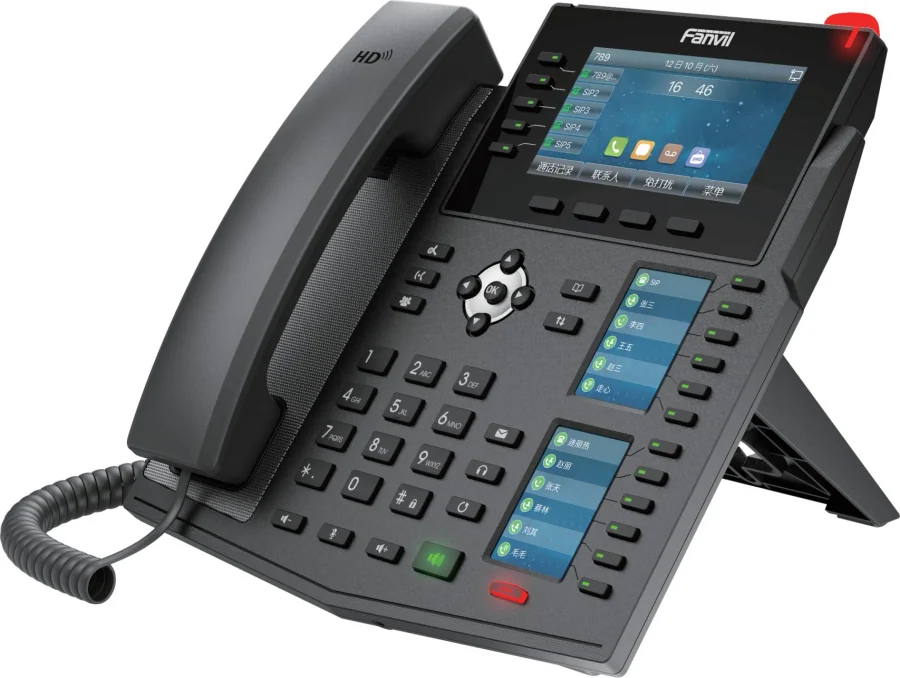
A site is rarely one model. An order can combine the PBX, SIP desk phones, wireless handsets, hotel terminals, intercoms and paging equipment on the same quotation, packed as one consignment and referenced as one configuration.
How an OEM order is agreed
There is no automated programme to sign up to. An OEM or customisation request is handled as a project: what you need is written down, checked against what is actually available for those models, and then confirmed in the quotation.
- 01
Send the requirement
Site type, the models or families you are considering, the language your users and installers need, and the branding files you hold.
- 02
Confirm what is available
We check the options that genuinely apply to those models against the current specification, and say plainly which ones do not apply.
- 03
Agree the configuration in writing
The extension plan, provisioning method, labelling and packing are written into the quotation and the proforma invoice.
- 04
Ship one configuration
Pre-configured units are packed as one consignment, with the labelling and documentation agreed for that order.
What this page does not promise
These subjects come up in every OEM conversation and none of them can be answered honestly from a website. They are confirmed in writing for your project:
- Certification or type approval for a specific market — tell us the destination country early and the available documentation for the models can be checked before the order is placed.
- Minimum order quantities, tooling or artwork costs, and lead times — these depend on the model, the batch and the customisation, and are stated per project on the quotation.
- Warranty and after-sales terms — these are issued with the quotation for each order, written against the models and quantity concerned.
- Prices — no price is published on this site. The configuration you describe is what a quotation is built from.
- Manufacturing — the range is manufactured by NEXVIA in our own plant. It is selected for the site, quoted as one configuration and shipped from Guangzhou.
What to send us
The first message does not need to be a specification. These five items turn it into a configuration:
- Site size — building type, number of extensions or rooms, and the areas to cover.
- Model list — the models or families you are considering, or the functions the site needs.
- Language — the language for the interface, voice prompts, labels and documentation.
- Branding files — logo artwork, model naming convention and packaging requirements.
- Destination — the market the goods are going to, and any documentation or approval it requires.
OEM and customisation — questions
Is NEXVIA the manufacturer of these systems?
Can our logo be applied to the phones and the PBX?
Can the system arrive already configured for our site?
Do you publish MOQs or lead times for OEM orders?
Can one order mix models for different parts of a site?
Our market requires certification — can you confirm it before we order?
Send the site and the branding requirement
Site size, model list, language, branding files and destination market — with those five, the reply is a concrete configuration instead of a capability statement.
Send the site details
Six facts build a configuration: site type, extensions or rooms, simultaneous calls, areas to cover, existing lines and the documents you already hold. Send as many as you know — nothing has to be final before the first reply.
- Reply within one working day
- Configuration + quotation for your site
- Your details are used only to answer this inquiry
Page author: NEXVIA EngineeringPublished: Last updated: