Hotels
How many lines does a guest phone need?
On this page
- The answer is already in the specification — what should you know?
- What the second line buys a guest room — what should you know?
- When one number per room is the better answer — what should you know?
- The guest models, as stated — what should you know?
- Where four or twenty lines are genuinely needed — what should you know?
- Line count is not the call-permission control
- Deciding in one pass
The answer is already in the specification — what should you know?
Line count is the first question a hotel buyer asks, and the least useful one to answer on its own, because the guest-room range in this project is almost uniform on it. Every model in the H series that states a SIP line count states two: the H603W, the H6W, the H5/H5W, the H3/H3W and the H2U all publish two SIP lines. On the H4/H4W, the H602/H602W and the H1 the count is not stated in the materials at all, and we do not fill that gap in for the sake of a tidy table.
So the real question is not "two, three or four" in the abstract. It is what the second line is for, whether a room position needs a third, and which positions in the property are not guest rooms at all.
What the second line buys a guest room — what should you know?
- A second number. A room can hold its internal extension and a published direct number at the same time. Direct inward dialling binds an outside number to an extension or a group and bypasses the auto attendant, so a caller reaches room 412 without hearing a menu.
- A second position on the same phone. Two lines let a second device - a bathroom phone, for example - share the room's handset and number instead of taking a new extension.
- A call that does not block the room. With one line occupied, a second caller gets a busy signal unless the switchboard has a free position to take it.
None of those are guest-facing features in the usual sense. Guests rarely dial a number from a room phone; they press a labelled key. That is why this range is organised around five or six service keys rather than around line count, and why two lines is the right default at the bedside: the first line is the room's extension, and the second exists for the second number the property decides to publish.
When one number per room is the better answer — what should you know?
Some properties deliberately reduce the count. The Hotspot function documented for the H6W, H5/H5W, H4/H4W and H3/H3W lets several phones share one number from the server while each phone keeps its own extension number. That is the honest way to have a bathroom phone and a desk phone in one room without paying for two published numbers, and it leaves the second line free on each handset.
A second line with nothing on it is not a fault, but a property that multiplies positions carelessly pays for it twice: once in the number plan, and once in the extension count the PBX has to hold. In the 120-room reference design on this site, 120 room phones plus 60 bathroom phones is 180 room-side extensions - and that number is what has to sit inside the published capacity of the core.
The guest models, as stated — what should you know?
| Model | Stated SIP lines | Service keys | Power |
|---|---|---|---|
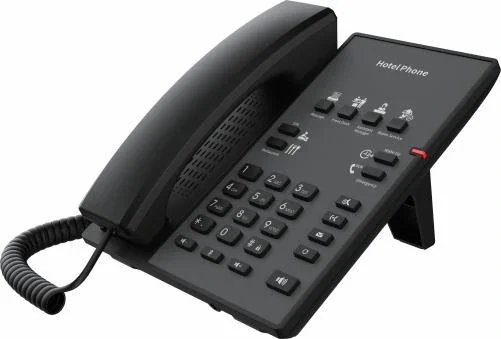
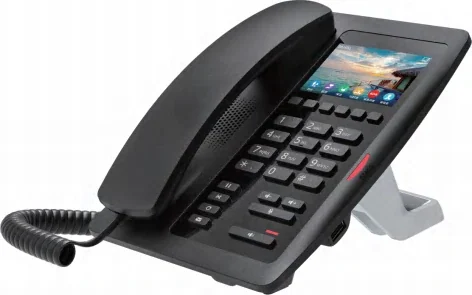
| H6W | 2 | 5 programmable service keys, 3.5-inch screen | Integrated PoE |
| H603W | 2 | 6 programmable service dials, cordless | Fast-charge base (QC3.0) |
| H5/H5W | 2 | 6 programmable service keys, 3.5-inch screen | PoE |
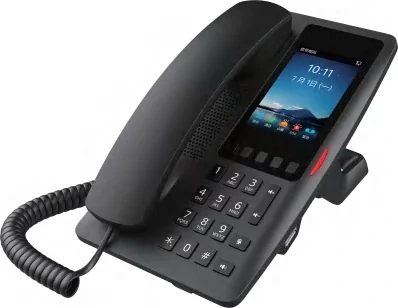
| H3/H3W | 2 (stated in the CN brochure) | 6 programmable service keys | Integrated PoE |
| H2U | 2 | 10 speed-dial keys plus 1 programmable key for door control | Integrated PoE |
| H4/H4W | Not stated | 5 or 6 soft keys - the two brochures disagree | Integrated PoE |
| H602/H602W, H1 | Not stated | 6 service keys; 8 programmable soft keys | PoE where stated |
Read the last two rows as they are written. An unstated line count is not a smaller one; it is a figure we confirm against the product documentation on the quotation rather than assume during design.
Where four or twenty lines are genuinely needed — what should you know?
The position that needs more lines is never the guest room. It is the front desk, reservations and the back office, where one person has to hold, transfer and watch several lines at once. The desk range answers with published numbers.
| Model | Stated SIP lines | Where it earns its place |
|---|---|---|
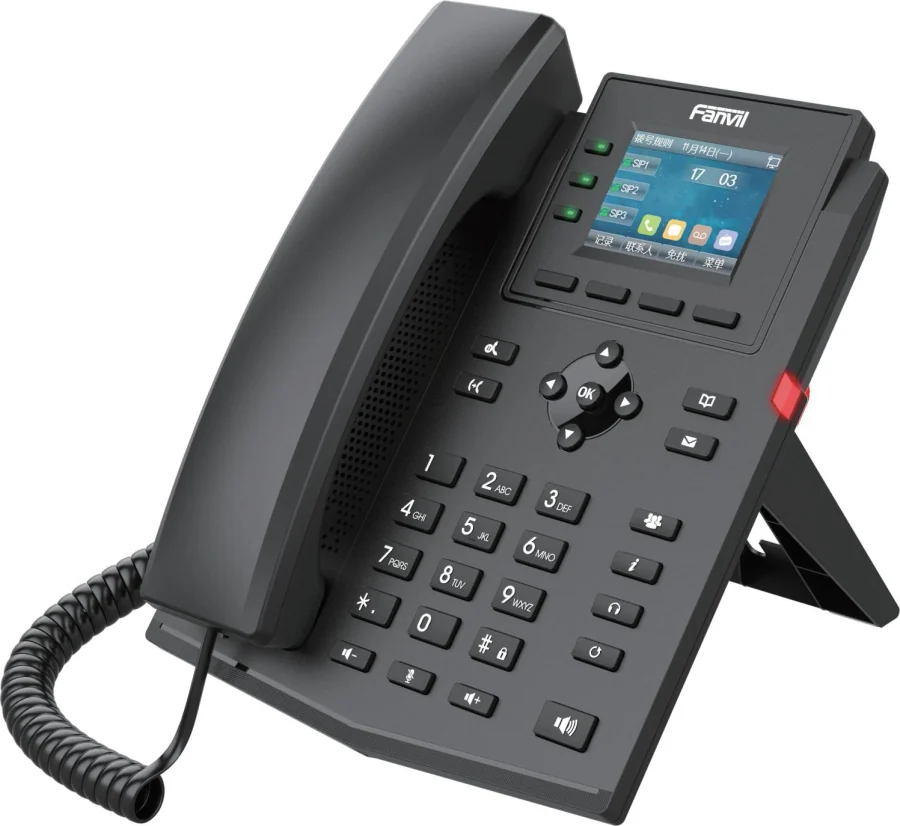
| X301 group | 2 | Stores, kitchen, service corridors |
| X303 group | 4 | Reservations, housekeeping office, engineering |
| X3U | 6 | The standard back-office desk |
| X4U | 12 | Supervisor positions |
| X5U | 16 | Busy multi-line desks |
| X6U, X210i, A320i | 20 | Front desk and switchboard, with side screens and DSS keys for busy-lamp fields |
Two design notes follow. First, the second Ethernet port on these phones is what lets a PC sit behind the handset, and on the X303 non-G variants that port is megabit rather than gigabit - worth knowing before a reservations terminal is placed in front of a workstation. Second, if the front desk needs two consoles rather than one large phone, the X210i carries 106 DSS keys and the A320i 116, on 20 SIP lines each.
Line count is not the call-permission control
Properties sometimes ask for extra lines so staff can be stopped from dialling out. That is the wrong lever. Outbound permission is set per extension in five levels - internal only, local, domestic (the default), international and barred - and call barring can restrict extensions or lines by weekday and time band. An extension lock stops outgoing calls from the handset entirely until it is released, which is the setting a property wants at check-out. Line count does not appear in that list.
Deciding in one pass
- Count guest-room positions and decide whether a room gets one handset or two; a second position doubles the room-side extension count.
- Give each guest phone two lines by default: the room extension, plus the number the property chooses to publish.
- Use the Hotspot function where a second position in a room should share the room's number instead of taking a new one.
- Put multi-line phones where the work is - 4 lines at reservations, 6 at a standard desk, 20 at the positions that watch a busy-lamp field.
- Control outgoing calls with the five permission levels and call barring, not with line count.
- Send us the room list, the positions per room and the staff positions. The handset mix and the PBX model follow from published capacities rather than from habit.