Skip to content

Scenarios · industry

Industrial Paging Systems — plant-wide announcements, alarms and radio on one platform

A factory paging system has to be heard over production, understood by people wearing hearing protection, and trusted as the route for an emergency announcement — and it usually has to coexist with a radio fleet, an old amplifier line and a set of alarm devices on the plant. The design on this page is the paging and intercom tier of that problem: SIP speakers and horns for coverage, gateways to bring the existing speaker line along, a console for dispatch, relay and short-circuit interfaces for plant signals, and radio integration where UHF handsets are already in use. Industry is one of the verticals named in the paging and intercom material, and industrial broadcast and intercom is a named scenario. NEXVIA designs, manufactures, supplies and commissions the system; the terminals and gateways are manufactured by NEXVIA.

  • Coverage figures you can design to: A233 horn at 30 W rated output and IP66, A212 at 8 Ω with up to 15 W class D, FH-S01 up to 20 W on PoE
  • Up to 20 multicast zones with prioritisation, so an announcement reaches one line, one hall or the whole plant
  • The existing amplifier line is bridged, not replaced: PA3 and PA2S publish a 10–30 W mono output with a line out for an external amplifier
  • Radio stays in the loop: the W712 integrates a UHF 400–470 MHz radio module with group calls between radios and SIP phones
  • Plant signals connect directly: 8 short-circuit inputs, 1 output and an RS-485 interface on the A330i console, relay in and out on the A513W
  • Scheduled messages, real-time text-to-speech and audio archiving are published capabilities of the paging tiers
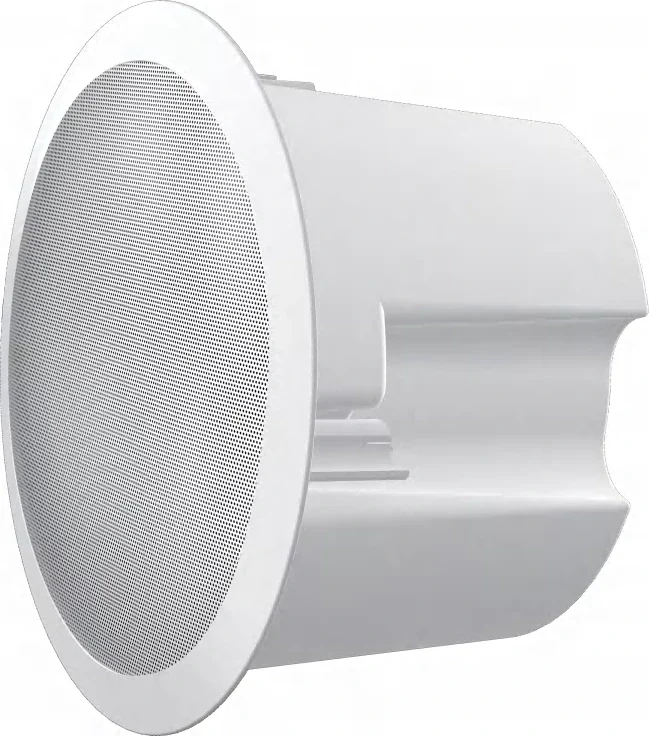
IP66 SIP speaker with a built-in camera for industrial paging and call positions

The short answer

Size a factory paging system by zones and by ambient noise, not by floor area. A plant with a machine shop, an assembly hall, a packing area, a yard, a canteen and offices is 6 zones before any aisle coverage; the speaker family supports up to 20 multicast zones with prioritisation, so the zoning is a design choice rather than a hardware limit. Behind it, one PBX publishes 62 SIP trunks on the OM50G and 496 on the OM200G, which is what carries the paging, the telephony and the gate calls together.

Three published power figures carry the audio design: the A233 horn at 30 W rated output for the yard and the loading areas, the A212 wall speaker at 8 Ω with up to 15 W class D output (PoE 8 W / PoE+ 15 W) and talkback, and the FH-S01 ceiling speaker at up to 20 W with a built-in class D amplifier on PoE to IEEE 802.3af. The A201 ceiling figure is printed two ways in the source, so its wattage is confirmed on the quotation rather than quoted from this page.

The plant side is where industrial paging differs from office paging. The A330i console takes 8 short-circuit inputs, 1 output and an RS-485 interface so alarm and control signals land at the dispatch desk; the A513W carries relay in and out for a PIR sensor, infrared sensor or strobe light; and the W712 puts one analog or DMR II radio on the same system as SIP calls, with group calls between them. Prices are not published on this site — every plant is quoted per zone count, radio channel count and cable condition.

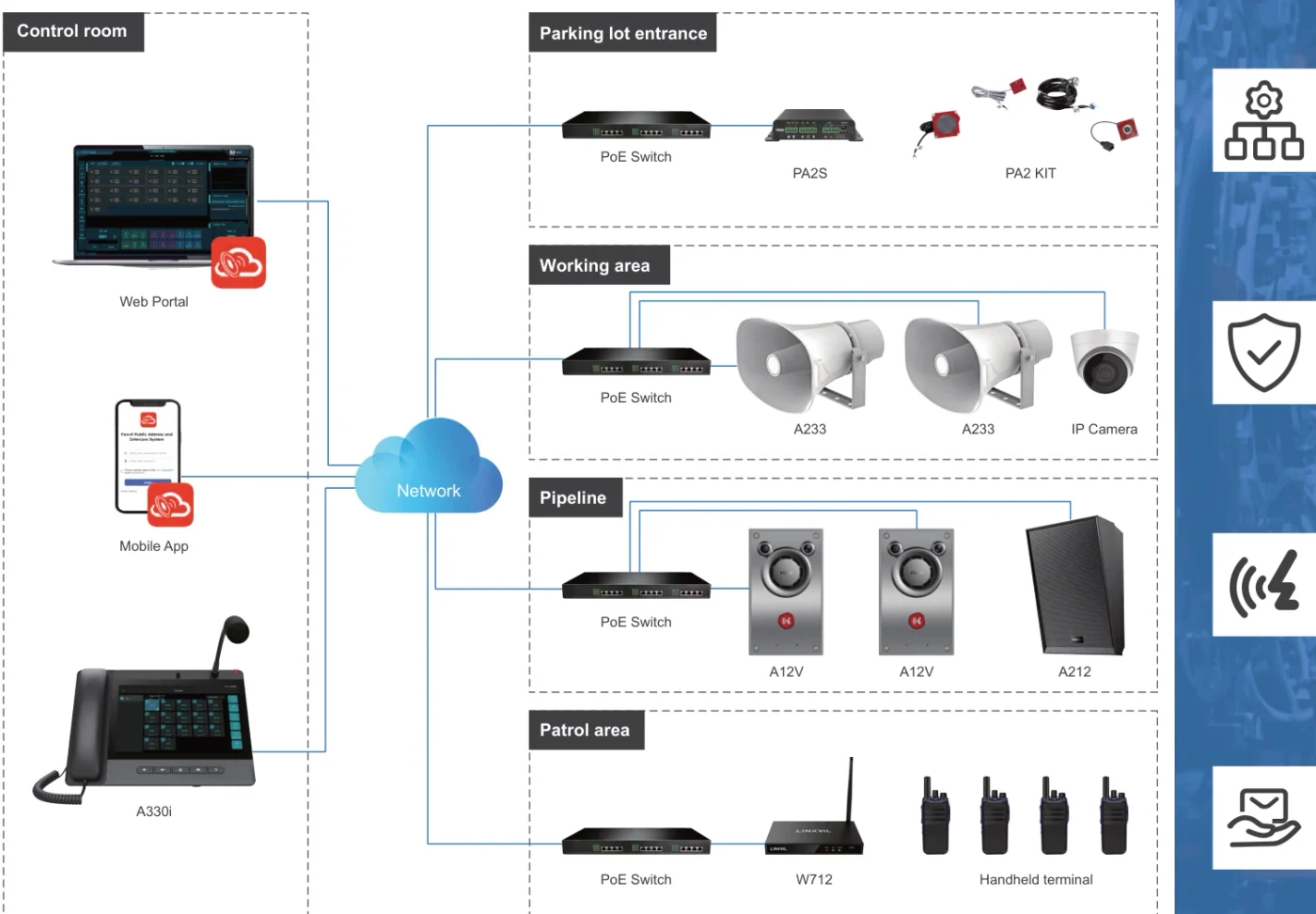
Paging architecture: the deployment tiers, and how zones and endpoints attach to them

What goes wrong on this type of site

Machinery does not stop for an announcement

Intelligibility is the whole job. Published output figures, environmental noise detection, zoning with prioritisation and remote volume adjustment per device are the tools; the ambient measurement at survey is the input.

The amplifier rack is someone else budget

Most plants have an analog paging line and a maintenance contract on it. The PA3 and PA2S gateways let that line stay while the new system grows zone by zone, which keeps the project inside one budget year.

Radios, phones and speakers are three systems

Until the W712 puts a radio channel onto the telephone system, the yard and the control room cannot talk. Group calls between radios and SIP phones are the documented behaviour that closes that gap, with recording for both.

Alarms that nobody can prove

An alarm path is only useful if it is tested. Short-circuit inputs at the console and the endpoints, self-test and monitoring on the speakers, and audio archiving give the plant a way to test and to prove what happened.

Choosing by size

Size bandSystemDevicesNotes
Workshop or light industrial unit — up to 6 zonesOM20G — 24 SIP trunks; 4 analog ports for a legacy line6–12 speakers (A212 / A201 indoors, A233 outdoors), 1 console (X210i), 2–4 wall handsets (V60G), 2–4 portable handsetsThe desktop chassis covers a single cabinet installation, and the OM20G is the only model that can dial out through a 3G/4G USB modem for a site whose line is unreliable.
Single factory or production hall — 6 to 12 zonesOM50G — 62 SIP trunks; up to 12 analog ports across 3 interface cardsSpeakers per zone indoors and outdoors, 1–2 gateways for the old amplifier line, 1 dispatch console, 4–8 portable handsets, 1 radio gateway per channelRing groups hold up to 40 extensions on this model, so a shift-change call or an alarm group that rings the dispatch desk, the gatehouse and a handset fits comfortably.
Multi-line plant or industrial estate — 12 to 20 zonesOM200G — 496 SIP trunks; up to 96 analog ports on 24-line interface cardsSpeakers per line and per outdoor area, dispatch consoles per control point, radio gateways per channel, handsets per shift, plant-room extensions4 hot-swap card slots, gigabit Ethernet and single or dual AC/DC power; up to 32 departments for group pickup and up to 60 extensions in a ring group at this size.
Multi-site industrial groupOM1000-UC — 1000 SIP trunks, up to 200 concurrent calls per trunkThe per-site counts repeated, a shared dial plan, extension ranges per site, DID numbers per site where departments publish direct linesSIP only, with dual hot standby (3 fixed IP addresses) and multi-site networking using unique or repeatable extension numbering.
Plant keeping its existing amplifier and speaker linesOM50G or OM200G — 62 or 496 SIP trunksPA3 or PA2S gateways per amplifier position, with new SIP speakers added zone by zone as the budget allowsThe IP endpoint tier is stated to bridge legacy paging systems into the IP environment. PA3 adds line in, USB 2.0 and TF storage plus camera linkage; PA2S stays compact with an SOS call key and a built-in relay.
Plant where UHF radios are already in useOM50G or OM200G — 62 or 496 SIP trunksW712 RoIP gateway per radio channel, with the existing radios and the SIP handsets in the same talk groupsThe W712 integrates a UHF 400–470 MHz radio module and supports one analog or DMR II radio plus one SIP call, with group calls between them and recording to a TF card up to 128 GB. Record the radio make, model and channel plan at survey.

Numbers behind the design

Industrial paging and intercom equipment, as published
ModelWhere it goesPublished output and capabilityPower and rating
A233Yard, loading areas, external wallsHorn speaker with 30 W rated output, high sound clarity and a built-in microphone for system self-test, monitoring, environmental noise detection, volume adjustment and two-way voiceIP66; PoE, PoE+ or DC; up to 20 multicast zones
A212Production halls, workshops, canteen walls2-way coaxial speaker with 8 Ω and up to 15 W class D output; talkback through an omnidirectional microphone; alarm linkage; offline timed broadcast10/100 Mbps Ethernet with integrated PoE (PoE 8 W / PoE+ 15 W); up to 20 multicast zones with prioritisation; wall mount with optional angle bracket
A201Ceilings in halls, offices and control roomsCeiling SIP speaker with a built-in microphone, system self-test, monitoring, environmental noise detection, two-way voice and offline timed broadcastPoE, PoE+ or DC; the rated output is printed two ways in the source, so the wattage is confirmed on the quotation
FH-S01Ceiling coverage where a stronger amplifier is neededUp to 20 W with a built-in class D amplifier, talkback, a customisable WAV for emergency notification and alarm, and linkage with security alarming devicesPoE to IEEE 802.3af; up to 20 multicast zones with prioritisation; all-in-one codec, amplifier and speaker
A513WUnattended area needing both a camera and a speakerAll-in-one SIP speaker with a built-in 4 MP HD camera with IR night vision, built-in microphones, H.264, dual-band 2.4G/5G Wi-Fi and BLE; relay in and out for a PIR sensor, infrared sensor or strobe lightIP66; PoE or DC; up to 10 W on a DC supply
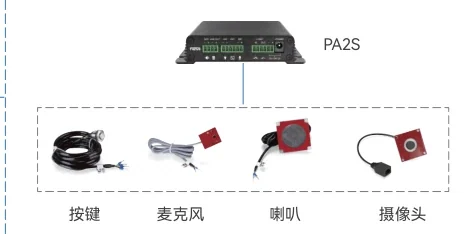
PA2SBridging an existing amplifier or speaker lineSIP intercom and paging gateway: 10–30 W mono output adapting to the input voltage, line out for an external active speaker, SOS call key, 1 short-circuit in and 1 out with a built-in relay, recording outputPoE to IEEE 802.3af or 12–24 V 2 A DC; −30 °C to 60 °C
PA3Larger legacy system with scheduled audio and camera linkageSIP paging gateway: 10–30 W mono output, line out, SOS call key, line in 3.5 mm, USB 2.0 and TF card, analog output to passive speakers or amplifiers, video linkage with an IP cameraPoE / PoE+ (IEEE 802.3at, published as PoE Class 4) or 12–24 V 2 A DC; −20 °C to 50 °C
A330i / X210iDispatch, control room and security deskA330i: 10.1-inch touchscreen, 116 DSS keys, 92 dB speaker, 8 short-circuit inputs, 1 output and 1 RS-485 interface, built-in broadcast system, Android 14. X210i: 106 DSS keys across three screens with a gooseneck microphoneDual Gigabit ports with integrated PoE; terminals used with the console are scanned and provisioned automatically
A12V / A11VGate, yard entrance and external call positionsA12V: 4 MP camera with IR night vision, 10W speaker with AEC, 2 short-circuit inputs and 2 outputs, anti-tamper alarm. A11V: 4 MP camera, 5W speaker, 2 in / 1 outIP66 and IK10, −40 °C to 70 °C; ONVIF and RTSP on the video models
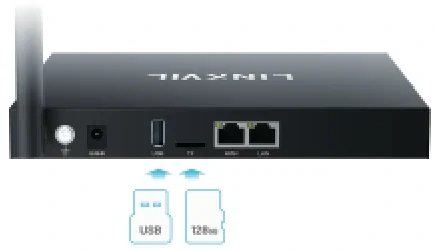
W712Radio room, one per channelRoIP gateway with a UHF 400–470 MHz radio module; one analog or DMR II radio plus one SIP call; group calls between radios and SIP phones; call recording and logs on a TF card up to 128 GB or USBNetwork plus UHF radio; SIP standard protocol; web deployment and management; trans-regional communication via DSS speed-dial keys
W611W / W620WSupervisors, marshals and maintenance staff16 DSS keys plus a configurable push-to-talk key. W611W: IP67, 1900 mAh, up to 9 h talk / 200 h standby. W620W: 3000 mAh, up to 13 h / 240 h, dual microphones, H.264 video previewWi-Fi 6 dual-band 2.4G and 5G; Bluetooth 5.0
This design against a conventional factory PA amplifier
RequirementConventional factory PA amplifierThis IP designWhat changes operationally
Zone controlRotary zone switches on the amplifier, one position per circuitUp to 20 multicast zones with prioritisation, addressed from a console or an IP phone; dynamic zone control and remote volume adjustment in the advanced tierAny combination of areas can be addressed from a screen, and levels can be trimmed per device
Scheduled announcementsA timer or a clock card in the amplifier rackScheduled broadcasting with custom time templates, plus offline timed broadcast held on the A201 and A212 speakers; real-time text-to-speech for typed messagesThe timetable is a configuration and survives a network interruption on the speaker side
Reaching people away from a speakerNothing: the announcement is the only channelPortable Wi-Fi 6 handsets with a push-to-talk key, and the W712 gateway putting existing radios into the same system as SIP callsThe announcement and the two-way conversation share one system
Alarm and control signalsA separate alarm panel with its own soundersShort-circuit inputs and relay outputs at the console and the endpoints: A330i 8 in / 1 out / RS-485, A12V 2 in / 2 out, PA2S 1 in / 1 out with a built-in relay, A513W relay in and outPlant signals, strobes and alarm buttons are part of the same installation
The existing speaker lineReplace the amplifier and the line togetherPA3 or PA2S gateways drive passive speakers and legacy analog horn speakers with a 10–30 W mono output and a line out for an external amplifierThe changeover happens zone by zone in planned shutdown windows
RecordsNoneAudio archiving of SIP paging, intercom and calls where the paging tier provides it; radio and SIP call recording on the W712; call detail records to a server on port 1809An announcement or an alarm event can be reviewed afterwards
Video linkageNot possible without a separate systemONVIF integration with third-party VMS platforms; AI camera events such as intrusion or loitering can trigger pre-recorded broadcasts; A513W combines a 4 MP IR camera and an IP66 speakerThe camera event and the announcement are one action

Deployment by area

AreaDeviceNote
Yard, loading area and external plantA233 horn speakerIP66 horn with 30 W rated output and a built-in microphone for system self-test, monitoring, environmental noise detection, volume adjustment and two-way voice; part of a family supporting up to 20 multicast zones with prioritisation.
Production halls and workshopsA212 wall speaker or A201 ceiling speakerA212: 8 Ω with up to 15 W class D output, talkback through an omnidirectional microphone and alarm linkage (PoE 8 W / PoE+ 15 W). A201: ceiling two-way audio with self-test and offline timed broadcast, its rated output confirmed on the quotation because the source prints it two ways.
Halls needing a stronger ceiling outputFH-S01 ceiling speakerUp to 20 W with a built-in class D amplifier, talkback, a customisable WAV for emergency notification and linkage with security alarming devices, on PoE to IEEE 802.3af.
Unattended areas with a camera positionA513W video speakerIP66 all-in-one SIP speaker with a 4 MP IR camera, built-in microphones, H.264, dual-band Wi-Fi and BLE, relay in and out for a PIR sensor, infrared sensor or strobe light, and up to 10 W on a DC supply.
Legacy amplifier and speaker linePA2S or PA3 SIP paging gatewayBoth publish a 10–30 W mono output that adapts to the input voltage and a line out for an external active speaker or amplifier; PA2S adds a built-in relay with 1 in and 1 out and an SOS call key, PA3 adds line in, USB 2.0, TF storage and camera linkage.
Gates and external call positionsA12V outdoor intercom (A11V for a sheltered goods entrance)A12V: IP66 and IK10 from −40 °C to 70 °C, 4 MP camera with IR night vision, 10W speaker with AEC and 2 in / 2 out. A11V: 4 MP camera, 5W speaker, 2 in / 1 out.
Dispatch, control room and radio roomA330i console with a W712 RoIP gateway; W611W / W620W handsets for staff on the moveA330i: 116 DSS keys, 92 dB speaker, 8 short-circuit inputs, 1 output and an RS-485 interface. W712: UHF 400–470 MHz radio module, one analog or DMR II radio plus one SIP call with group calls and recording. Handsets add a push-to-talk key over Wi-Fi 6.

Questions buyers ask

How many zones does a factory paging system need?

Enough that a message goes where it is relevant and nowhere else. A typical plant starts at 6 zones — machine shop, assembly, packing, yard, canteen and offices — and grows as lines are added; the speaker family supports up to 20 multicast zones with prioritisation.

  • Outdoor and high-noise areas take a horn: the A233 publishes 30 W rated output at IP66 with environmental noise detection.
  • Indoor halls take the A212 wall speaker (up to 15 W class D with talkback) or the A201 ceiling speaker, whose wattage is printed two ways in the source and is confirmed on the quotation.
  • Each zone should be a separate run so it can be addressed and volume-adjusted independently; remote volume adjustment per device is a published capability of the advanced tier.

How do we keep the existing PA amplifier and speakers?

Bridge them. The PA3 and PA2S gateways publish a 10–30 W mono output that adapts to the input voltage and a line out for an external active speaker or amplifier, so the existing passive speakers and horn speakers continue to work while new SIP speakers are added zone by zone.

  • The IP endpoint tier is stated to bridge legacy paging systems into the IP environment, which is what makes a hybrid plant normal rather than a compromise.
  • PA2S is the compact option with a built-in relay and an SOS call key; PA3 adds line in, USB 2.0 and TF storage and can link to an IP camera.
  • Where the old building has no data cable either, PN1 carries network and power over an existing two-core pair, up to 1600 m for the network function without power.

Can our radios and the telephone system work together?

Yes, through the W712 RoIP gateway. It integrates a UHF 400–470 MHz radio module and supports one connection of an analog or DMR II digital radio plus one SIP call, with group calls between radios and SIP phones.

  • Call recording and logs cover both radio and SIP traffic, stored on a TF card up to 128 GB or on USB storage.
  • The gateway is documented as compatible with mainstream analog and digital radios and with most mainstream IP PBX platforms.
  • One gateway covers one radio channel, so the number needed follows the site talk groups — record the radio make, model and channel plan at survey.

How does an alarm reach the whole plant?

Through the same system, with priority. One-key alarm activation, alarm light flashing and simultaneous calling to the management unit are stated for the IP endpoint tier, and zones can be addressed together with prioritisation over routine announcements.

  • The contact interfaces are published per device: A12V has 2 short-circuit inputs and 2 outputs, PA2S has 1 in and 1 out with a built-in relay, A513W has relay in and out for a PIR sensor, infrared sensor or strobe light, and the A330i console has 8 inputs, 1 output and an RS-485 interface.
  • Speakers on the range carry self-test, monitoring and environmental noise detection, which is how a fault in the announcement path is noticed before an incident.
  • The interface to a fire detection system, and the priority of an alarm announcement over a routine one, are regulated locally and belong to the fire contractor and the code authority rather than to this page.

How do we prove what was announced?

With the recording features published for the tiers: audio archiving automatically records SIP paging, intercom and calls and makes them available online for review or download where the advanced paging tier provides it, and the W712 records radio and SIP calls to a TF card up to 128 GB or USB storage.

  • Call detail records can be pushed to an external server on port 1809 for the telephony side.
  • The interactive digital map in the advanced tier shows device state on building plans, which shortens the fault-finding route.
  • Retention, notice to the workforce and what may be recorded are site and national policy questions, not equipment features.

Which industries is this designed for?

The material lists industrial and mining sites, transport and rail, energy and power, education, finance, correctional facilities, medical sites, highways and unattended sites among the target environments, with industrial broadcast and intercom named as a scenario in its own right.

  • Industrial broadcast and intercom is described with four functions: intercom, announcement playback, video surveillance linkage and emergency consultation.
  • Unattended environments — car parks, stadiums, gyms, supermarkets — are named as sites the range is built for, which is why the anti-tamper and relay features exist.
  • The same platform carries the office telephony, so a plant office, a gatehouse and a control room share one dial plan.

What happens during a power or network failure?

Analog lines on FXO ports keep working directly, outbound SIP calls can fall back to an analog line when the trunk fails, and speakers with offline timed broadcast keep their scheduled messages running on their own.

  • The OM1000-UC supports dual hot standby across 3 fixed IP addresses with a 10-second health heartbeat, and ETH1 to ETH2 failover takes about 1.75 seconds.
  • The OM20G can dial out through a 3G/4G USB modem where no wired line reaches the site.
  • Alarm notification can call a nominated number on events such as trunk registration failure, analog line failure or a SIP attack.

Cabling, power and network notes

  • Each speaker is its own run so the zone can be addressed and levelled independently; PoE is the default supply where published — A212 as PoE 8 W / PoE+ 15 W, A201 on PoE, PoE+ or DC, FH-S01 to IEEE 802.3af, A233 on PoE, PoE+ or DC.
  • Outdoor and plant-floor positions must match their rating: A233 and A513W are IP66, A12V is IP66 and IK10 from −40 °C to 70 °C, i16S/i16SV is IP65 and IK10 from −30 °C to 60 °C, and the PA2S and PA3 gateways run from −30 °C to 60 °C and −20 °C to 50 °C respectively.
  • Where an analog amplifier line is kept, the PA3 or PA2S output feeds it; both publish a line out for an external active speaker and can drive passive speakers directly, so the old rack becomes a zone rather than an obstacle.
  • Relay and contact wiring carries the plant signals: A330i 8 in / 1 out plus RS-485, A12V 2 in / 2 out, A11V 2 in / 1 out, PA2S 1 in / 1 out with a built-in relay and A513W relay in and out for a PIR sensor, infrared sensor or strobe light.
  • The W712 needs a network drop and a radio feed at the rack; record the channel plan and the radio model, because group calls join radios to SIP phones and the recording covers both.
  • Where no data cable reaches a plant building, PN1 puts network and power onto an existing two-core pair, up to 1600 m for the network function without power, with local supply at AC 100–240 V.
  • Keep the zone schedule, the relay map and the radio channel list with the as-built drawings, and verify the emergency announcement path at every periodic test rather than only at handover.

The zone and device plan, area by area

Typical industrial zoning and the device for each area

AreaDeviceZone behaviourWhy this device
Yard and loading bankA233 hornOwn zone, outdoor rated30 W rated output at IP66 with environmental noise detection
Production hallA212 wall or FH-S01 ceilingOne zone per line or per bay15 W class D with talkback, or 20 W on PoE 802.3af where more output is needed
Offices and control roomA201 ceilingOwn zone with a lower levelEven indoor coverage with two-way voice and offline timed broadcast
Canteen and welfare areasA212 wallOwn zone with a local volume knobTalkback and a volume control staff can reach
Unattended area or storeA513W video speakerOwn zone with relay contacts for a strobeCamera and speaker in one IP66 enclosure with relay in and out
Gates and goods entrancesA12V / A11VExtension in the security call groupCamera, 10W speaker and 2 in / 2 out for the barrier
Legacy buildings on an amplifier linePA2S / PA3 gatewayBridged zone per amplifier10–30 W mono output and a line out for the existing rack
Control room and dispatchA330i consolePaging control and alarm display116 DSS keys, 92 dB speaker, 8 in / 1 out / RS-485
Supervisors and maintenanceW611W / W620W, or the W712 radio gatewayPortable extension with push-to-talk, or radio talk groupsReaches the person, and joins the existing radio fleet to the system

The zone plan is the document that keeps the system usable: without it, every announcement becomes plant-wide and employees stop listening to any of them.

Three ways to deploy it

  • Server-based tier: cloud or on-premise B/S architecture for multi-site management, with high loading capacity, dynamic zone control, remote volume adjustment and real-time text-to-speech.
  • Serverless tier: built around a console phone, removing the need for a dedicated server, with auto terminal provisioning and zone management from a 10.1-inch screen — the option for a single plant with no rack space.
  • IP endpoint tier: fully compatible with SIP, bridging legacy paging into the IP environment, with PoE supply, short-circuit inputs for alarms and ONVIF for camera linkage.
  • Devices across all three tiers can be scanned and provisioned automatically by the A330i, A320i and A308i consoles, which is what keeps commissioning time down on a large plant.

Alarms, linkage and records on a plant

  • One-key alarm activation, alarm light flashing and simultaneous calling to the management unit are stated for the IP endpoint tier.
  • Relay and contact interfaces let plant devices act on the system and the system act on plant devices: A513W relay in and out for a PIR sensor, infrared sensor or strobe light; PA2S 1 in / 1 out with a built-in relay; A330i 8 in / 1 out and RS-485.
  • ONVIF integration means the intercom and paging terminals can be linked to a VMS, and AI camera events such as intrusion or loitering can trigger pre-recorded broadcasts.
  • Audio archiving of SIP paging, intercom and calls is published where the paging tier provides it, and the W712 records radio and SIP calls to a TF card up to 128 GB or USB storage.
  • Call detail records can be pushed to an external server on port 1809, so the telephony side has its own audit trail.

Compliance, standards and local requirements

Emergency broadcast and the fire interface

Where a plant paging system also carries emergency announcements, the interface to the fire detection system and the priority of an alarm announcement over a routine one are regulated locally. The published capabilities that matter are up to 20 multicast zones with prioritisation, one-key alarm activation, alarm light flashing, simultaneous calling to the management unit, and short-circuit inputs on consoles and gateways. Have the fire interface designed and signed off by the plant fire contractor, and keep the announcement path testable: speakers on the range carry self-test, monitoring and environmental noise detection, which is how the installation is kept honest between inspections. This page makes no certification claim.

Noise, hearing protection and intelligibility

In a production hall the announcement has to be intelligible above machinery, and the people who must hear it are often wearing hearing protection. Design the coverage from the measured ambient level, not from a rule of thumb: the published figures are 30 W rated output on the A233 horn, up to 15 W class D on the A212, up to 20 W on the FH-S01 and up to 10 W on the A513W at DC, with environmental noise detection and remote volume adjustment available. Mounting heights, the zoning of a hall, the use of visual alarm devices and the plant noise-control policy are site matters that should be agreed with the safety officer before the speaker schedule is fixed.

PoE, power and outdoor protection

Paging equipment in a plant is exposed equipment. Published ratings are IP66 for the A233 horn and the A513W video speaker, IP66 and IK10 from −40 °C to 70 °C for the A12V, IP65 and IK10 from −30 °C to 60 °C for the i16S/i16SV, −30 °C to 60 °C on the PA2S gateway and −20 °C to 50 °C on the PA3. On the power side, PA2S is PoE to IEEE 802.3af, PA3 is PoE/PoE+ (IEEE 802.3at, published as PoE Class 4) with 12–24 V 2 A DC as the alternative, A212 is published as PoE 8 W / PoE+ 15 W and A201 takes PoE, PoE+ or DC. Cable classes, containment, separation from power and earthing are local industrial wiring rules — confirm them before first fix.

Radio licensing and recording in the workplace

The W712 puts UHF 400–470 MHz radios onto the telephone system, and radio spectrum use, power limits and licence conditions are regulated nationally: the plant own radio licence and its conditions apply to whatever the gateway is connected to. Recording is the second question, because audio archiving of SIP paging, intercom and calls and radio call recording on the W712 both capture workplace speech. What may be recorded, how long it is kept and what the workforce is told are local determinations. Confirm the radio licence position and the recording policy with the plant own compliance owner before the gateway is installed.

Standards referenced

Frequently asked questions

Can we keep the existing factory PA amplifier?

Yes. The PA3 and PA2S gateways drive passive speakers and legacy analog horn speakers with a 10–30 W mono output and a line out for an external amplifier, and the IP endpoint tier is stated to bridge legacy paging into the IP environment.

How many zones can one system control?

The speaker family supports up to 20 multicast zones with prioritisation, addressed from a console or an IP phone, with dynamic zone control and remote volume adjustment in the advanced tier. A plant with more areas groups them into zones.

Can the paging system talk to our radios?

Through the W712 RoIP gateway: a UHF 400–470 MHz radio module, one analog or DMR II radio plus one SIP call, group calls between radios and SIP phones, and recording to a TF card up to 128 GB.

How loud is the outdoor horn?

The A233 is published at 30 W rated output with IP66 protection and a built-in microphone for self-test, monitoring, environmental noise detection and two-way voice. Position count follows the measured ambient level at survey.

Can a camera event trigger an announcement?

Yes. The endpoints support ONVIF and connect to third-party VMS platforms, and when paired with AI cameras they can automatically broadcast pre-recorded alerts triggered by events such as intrusion or loitering. The A513W combines a 4 MP IR camera and an IP66 speaker in one enclosure.

Do we need a server for the paging system?

Not necessarily. The serverless tier is built around a console phone, with auto provisioning of terminals and zone management from its touchscreen; the advanced tier uses cloud or on-premise B/S architecture where multi-site management or text-to-speech is needed.

How is the announcement path tested?

Speakers on the range carry system self-test, monitoring and environmental noise detection, audio archiving records SIP paging and intercom traffic where the tier provides it, and the relay and input map at the console lets the alarm path be exercised deliberately rather than assumed.

Project evidence

We have not published a named reference project on this page. The site does not carry customer names or installation records until the client confirms in writing which projects may be made public.

Page author: NEXVIA EngineeringPublished:Last updated:

Covers: industrial paging system · factory pa system · industrial public address system · paging system for factory · warehouse pa system

All IP telephony, intercom and paging equipment in this design is supplied and integrated by NEXVIA.

Already decided on a platform, or replacing a system?

Explore Products

Related products

Planning an IP telephony project?

Send us the site type, the number of extensions or rooms and the areas to cover — we will come back with a configuration and quotation.

Send the site details

Six facts build a configuration: site type, extensions or rooms, simultaneous calls, areas to cover, existing lines and the documents you already hold. Send as many as you know — nothing has to be final before the first reply.

  • Reply within one working day
  • Configuration + quotation for your site
  • Your details are used only to answer this inquiry

* required