Hotels
100-room hotel phone system: the checklist
Four numbers decide the whole list — what should you know?
A 100-room property is not a 100-extension property. Four counts drive the equipment list, and only the first one is obvious:
- Guest rooms - the room phones, one per room as the baseline.
- Second positions - a bathroom or bedside handset, if the property decides to fit one. This is where a 100-room design quietly becomes a 150-extension one.
- Staff positions - front desk, duty manager, reservations, housekeeping, engineering, F&B, kitchens, stores.
- Non-phone positions - lifts, fax, alarm diallers, the panic line at reception. These need analog ports or gateways, and they never appear on an architect's room schedule.
Take a property of 100 rooms with 50 second positions and 24 staff extensions. That is 174 extensions in total, before a single lift line is counted.
What follows from each count — what should you know?
| Position | Device and quantity | What it needs on the network |
|---|---|---|
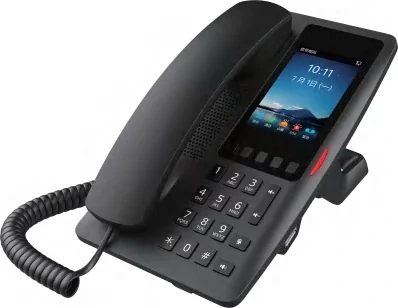
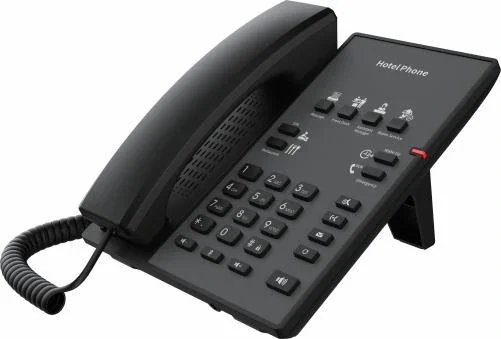
| Guest room | 100 room phones, service keys named for the property's own services | One PoE port each; the H6W also carries a USB-A charging port and Wi-Fi 6 |
| Bathroom or second position | 50 wall or desk handsets with speed-dial keys | One PoE port each; a second position in a room can share the room's number with the Hotspot function |
| Front desk | 2 consoles - 20 SIP lines and 106 to 116 DSS keys each | PoE; a gooseneck microphone position on the desk |
| Back office | 6 to 12 desk phones, four SIP lines each | PoE, dual gigabit ports if a PC sits behind the phone |
| Duty and housekeeping | 8 to 12 portable handsets | Wi-Fi coverage, no fixed cable; up to 16 DSS keys and a PTT key |
| Back of house | 1 to 2 SIP wall speakers | PoE for paging dialled from reception as an ordinary call |
| Lift, fax, alarm | Analog ports on the PBX, or an ATA gateway where the core has none | The pair that already exists, terminated on FXO or FXS ports |
Choosing the core — what should you know?
The room count does not choose the PBX; the extension count and the analog requirement do. This platform publishes maximum SIP trunks rather than extensions: 24 on the OM20G, 62 on the OM50G, 216 on the OM80E, 496 on the OM200G and 1000 on the OM1000-UC, with up to 120 concurrent calls on a single trunk (200 on the OM1000-UC).
For a 174-extension property with the lift, fax and alarm lines still on copper, the choice is between the OM80E and the OM200G, and the deciding column is analog:
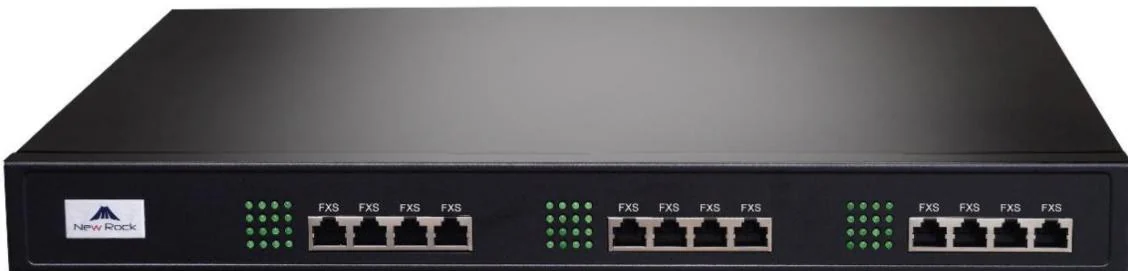
- OM80E - up to 48 analog ports across three card slots, in thirteen sub-models from 8 FXS/8 FXO to 48 FXO. 216 SIP trunks.
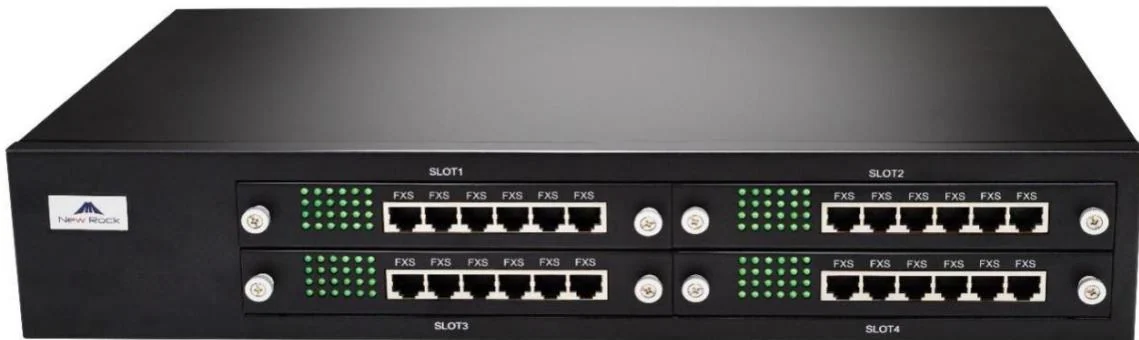
- OM200G - four card slots taking 24FXS, 24FXO, 16FXS+8FXO or 12FXS+12FXO cards, up to 96 analog ports, all hot-swappable. 496 SIP trunks.
The reference design for a 120-room property on this site lands on the OM200G with one 12FXS+12FXO card and four FXO ports wired, and the reason is headroom: a hotel adds service extensions - a spa desk, a second lift, a pool bar - for years after handover, and the OM200G's 496 trunks absorb them without new hardware.
The items that are always forgotten — what should you know?
- Escape route. Four analog lines on FXO ports let an outbound SIP call fall back to copper when the trunk times out or returns a 4xx, 5xx or 6xx response - with 401, 404 and 422 excluded so that numbering errors do not silently reroute to a paid line.
- Property management link. Room status is set from the room extension with a feature code and pushed to the property's PMS over the PBX API, and the hotel management module is the stated integration for room status and call-permission control. That is a data route to the PMS server, not a port in the guest room.
- Wake-up calls. A system feature of the OM series, with its own voice prompt file, driven from the front-office software. No extra box.
- Recording. Recording runs in G.711 and G.729 only. The OM20G and OM50G record locally as well as to a server; from the OM80E upwards recording is to a recording server, whose address and port - 1311 by default - belong in the network plan.
- Call detail records. Pushed to an external server on port 1809 by default, which is what a call-accounting system consumes.
- Spare PoE ports. 20 per cent, counted before the switches are ordered, because the DECT base or access point added in year two is cheaper than a second switch.
Ports and power, counted before watts — what should you know?
PoE planning on the telephony side is arithmetic: 100 room phones plus 50 second positions plus staff desk phones and consoles plus the speakers is roughly 175 powered devices, which is nine 24-port switches with the spare allowance. Two published consumption figures give the scale of the load: the ES282-PCG and WS210 state 1.4 to 2.6 W, and the ES210 states 1.5 W, all at PoE IEEE 802.3af class 0. A speaker is the exception worth budgeting for: the A212 states PoE 8 W and PoE+ 15 W, so a zone that must hit full output needs the PoE+ budget at the switch port.
What to send us
Room count, second positions per room, and the staff position list - plus every analog device that has to keep working and whether the property wants call recording and where it should live. From those answers the PBX model, the card mix, the extension count and the switch count follow from published capacities, and nothing has to be guessed.