Skip to content

Scenarios · video entry

Video Door Phones — see the visitor, speak, and release the door from one station

A video door phone is judged at the door: how quickly a visitor can call, how clearly the resident sees them, and whether the door opens from the screen rather than from a walk down the stairs. The range documented here covers that chain from a 7-inch face-recognition station on a main entrance to a compact 86-box panel at a flat door, with indoor units that also take alarm inputs and a guard station that can watch several doors at once. This page is the range explained by what each model does, which entrances it fits and what it needs to be installed. NEXVIA designs, manufactures, supplies and commissions the system; the door phones and indoor units are manufactured by NEXVIA, including the range used throughout this design.

  • Six access methods on the face-recognition range: face, IC/ID card, PIN, QR code, DTMF and app
  • Anti-spoofing liveness detection against images, videos and masks on the i67 and i68
  • Door release as a relay action: one relay on the A10W and the i60 series, 2 short-circuit outputs on the A12V, and 64 to 128 outputs on the EC20 for floors and lifts
  • Indoor units carry 8 alarm inputs and 1 embedded relay, so a fire or gas alarm can be wired to the same device that answers the door
  • Video published in H.264, with H.265 optional on several indoor models, and ONVIF linkage so the call and its camera can meet on a VMS
  • Accessories that make the fit possible: RC01 and RC02 rain covers, EX101 to EX103 flush kits and a desktop swivel bracket
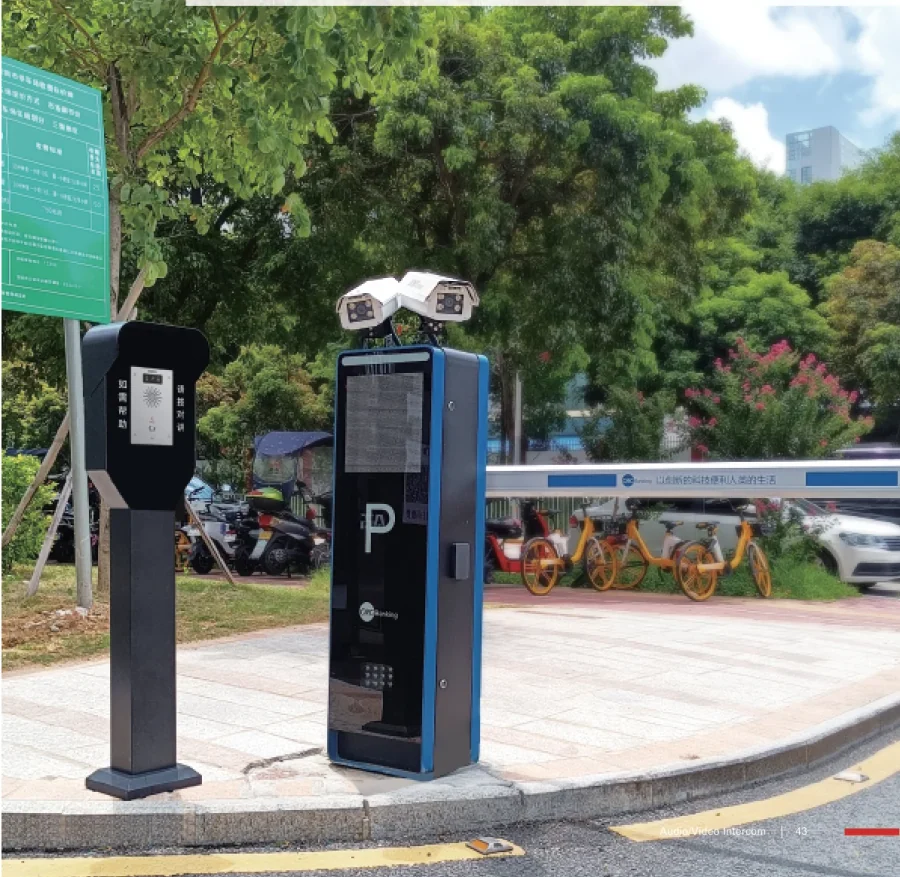
Face-recognition video door phone with a touchscreen for a building entrance

The short answer

Pick the station by the entrance, not by the price list. A high-traffic lobby takes the i67 or i68 with a 7-inch or 8-inch touchscreen and six access methods; a cold or exposed position takes the i66 or the i64 to i61 range published from −40 °C; a compact column takes the i60 or i60K at IP65 with a rain cover; and an internal flat or suite door takes the A10W in a standard 86 box with one relay.

Inside the building, the answering side is where the money goes. An indoor unit answers the call, shows the visitor on a screen (up to a 10.1-inch 1280×800 panel), offers one-touch unlocking and carries 8 alarm inputs and 1 embedded relay for an external fire or gas alarm; a guard station such as the A308 or A320 answers for a whole lobby and integrates IP cameras for monitoring. Under the range sits a PBX publishing 24 to 1000 SIP trunks, so each entrance is an extension rather than a wire back to a switchboard.

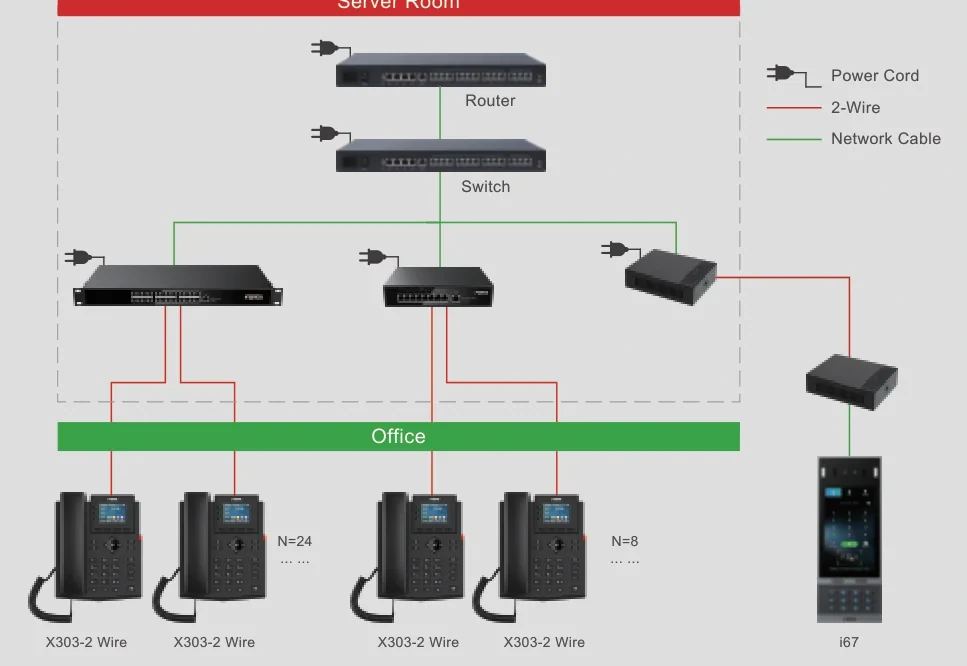
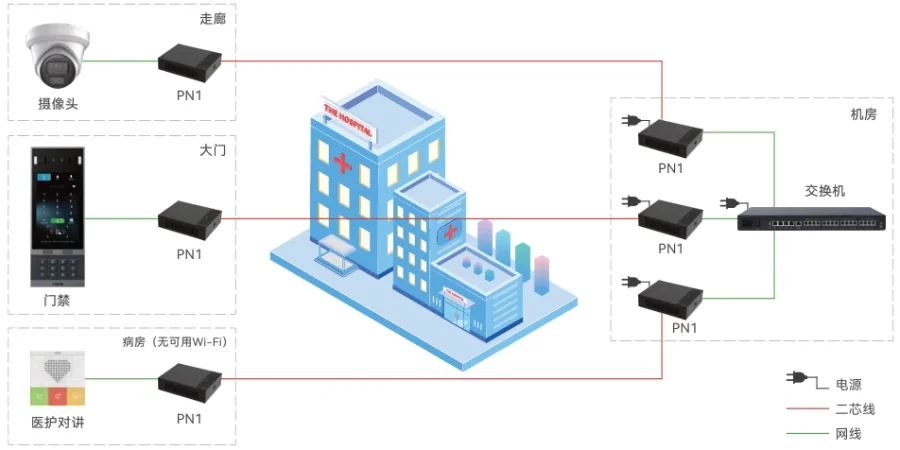
Most retrofits come down to two published figures. Where only two-core cable exists, the PN1 converter carries network and power over the existing pair and reaches up to 1600 m for the network function without power, while PN8 and PN24 distribute up to 8 and up to 24 devices at a maximum connection distance of 300 m for network plus power. Prices are not published on this site — every building is quoted per entrance count, unit count and cable survey.

Two-core topology: network and power carried over the cabling already in the wall

What goes wrong on this type of site

The visitor who cannot find the button

An entry station is used by people who have never seen it before. Six access methods mean residents and staff rarely need the button, a numeric keypad with a directory or per-flat code reaches the rest, and the guard station or app can route anyone who is still stuck.

Nobody answers the flat

Deliveries arrive when the resident is out. The call is an ordinary SIP call, so it rings a group, reaches the guard station, or arrives on an app where the cloud layer is used — the point being to design the order rather than discover it at the door.

The old cable is the deciding fact

A retrofit lives or dies on the pair already in the wall. The published figures are up to 1600 m on PN1 for the network function without power and 300 m on PN8 and PN24 for network plus power; measure before committing, and use 433 MHz buttons where no pair exists at all.

The door has to open the first time

A camera that is not linked, a relay that is not wired to the strike, or a lock that nobody has decided about are the usual causes of a failed handover. The relay map, the ONVIF link and the fail-safe decision belong in one document signed by the intercom, access and fire parties.

Choosing by size

Size bandSystemDevicesNotes
Single entrance — house, villa, small officeOM20G — 24 SIP trunks; 4 analog ports if a gate line is kept1 entrance station (i60K / A12V / A10W), 1–4 indoor units (i501), 1–2 handsetsThe OM20G is also the only model that can dial out through a 3G/4G USB modem, which suits a remote gate with no wired line. Ring groups hold up to 40 extensions.
Block of flats — 1 to 3 entrances, up to 60 unitsOM50G — 62 SIP trunks; up to 12 analog ports across 3 interface cards1–3 entrance stations (i67 / i60K / A12V), 1 guard station (A308), one indoor unit per flat, 1–2 lift or barrier positionsThe residential material states the system is compatible with standard IP PBX and needs no proprietary servers. A maximum number of indoor stations per system is not stated, so the unit count is confirmed on the quotation.
Commercial building — 4 to 8 entrances, mixed tenant and visitor trafficOM200G — 496 SIP trunks; up to 96 analog ports on 24-line interface cardsEntrance stations per door, guard or reception stations, indoor units at reception and in executive suites, lift control where floors are restricted4 hot-swap card slots and gigabit Ethernet, with the option of an A330i console at the security desk carrying 8 short-circuit inputs, 1 output and an RS-485 interface.
Estate or campus — several buildings and phasesOM1000-UC — 1000 SIP trunks, up to 200 concurrent calls per trunkPer-building station and unit counts repeated across phases on one dial plan, with DID numbers where entrances share a public numberSIP only, with dual hot standby (3 fixed IP addresses) and multi-site networking using unique or repeatable extension numbering.
Retrofit where the old cable is all that existsOM50G or OM200G — 62 or 496 SIP trunksNew stations at the existing door positions, with PN1 converters per point and PN8 or PN24 switches per riserPN1 carries network and power over an existing two-core cable with an external AC 100–240 V supply; the historical-building retrofit is the labelled use case for the 2-wire converter in the residential material.

Numbers behind the design

Video door phone range, as published
ModelEntrance it fitsCamera, access and audioProtection, mounting and connection
i67Main entrance, community, apartment and office building7-inch HD touchscreen; face, IC/ID card, PIN, QR code, DTMF and app; two 2 MP wide-angle cameras with automatic fill light; 3W speaker with AEC; line-out for an induction loop antenna; anti-spoofing liveness detection for images, videos and masksFull aluminium alloy; IP66 and IK07; −20 °C to 60 °C; SIP and ONVIF; Wiegand; numeric keypad
i68Main entrance where a larger screen is wanted8-inch HD touchscreen; the same six access methods; two 2 MP cameras with fill light; 3W speaker with AEC; line-out for an induction loop antennaIP66 and IK07; −20 °C to 55 °C; SIP and ONVIF; Wiegand; RC02 rain cover and EX103 flush kit available
i66Cold or exposed entranceAll-aluminium body with a colour-light keypad and a numeric keypad; two 2 MP cameras; face, card, PIN, QR, DTMF and appIP66 and IK07 from −40 °C to 60 °C; SIP and ONVIF
i64Entrance where cards and codes are the normNumeric keypad; password, IC/ID card, indoor switch, DTMF and scheduled door opening; one 2 MP wide-angle camera with IR night vision; 2.5W speaker with AECIP66 and IK07 from −40 °C to 70 °C; SIP and ONVIF; line-out for an induction loop; TF card slot up to 128 GB; RC01 and EX102 available
i63 / i62 / i61Entrance where speed dial or a single button is enoughi63 has five speed-dial buttons, i62 one speed-dial button and i61 one speed-dial touch button; card, indoor switch, DTMF and scheduled door opening; 2 MP camera with IR night vision; 2.5W speaker with AECIP66 and IK07 from −40 °C to 70 °C; SIP and ONVIF; TF card up to 128 GB
i60 / i60KCompact gate, column or second doorQuick call button (i60K adds an optional numeric keypad); IC card, PIN (i60K), BLE unlocking, DTMF and app; 2 MP camera with IR night vision; 1W speaker with AECIP65 with the rain cover; 12 V DC or PoE; 1 relay, 1 short-circuit in and 1 out; Wiegand badge
A10WFlat door, suite door, service doorThree function keys; 2W speaker with echo cancellation; one relay; one short-circuit input for an external emergency button; supports KT10/KT20/KT30 wireless buttonsStandard 86 box; PoE or 12 V DC; IP54; −10 °C to 50 °C; one-click call rings the host plus the call-group extensions
A12V / A11VGate, vehicle entrance, yard doorA12V: 4 MP camera with IR night vision, 10W speaker with AEC, 1 access-control relay, 2 short-circuit inputs and 2 outputs. A11V: 4 MP camera, 5W speaker, 2 in / 1 outIP66 and IK10 from −40 °C to 70 °C; anti-tamper alarm to the control centre; ONVIF and RTSP on the video models
i501 / i504 to i506WIndoor unit in the flat or suitei501: 3 DSS keys with one-touch unlocking or calling, 1W speaker with AEC, Wi-Fi 6 and PoE. Screened models: up to 10.1-inch 1280×800, H.264 with H.265 optional, visual call and remote door opening, 8 alarm inputs and 1 embedded relayWall mounted with PoE integrated; built-in 2.4G/5G Wi-Fi; one-touch family call and multi-party full-duplex voice
A308 / A320Guard or concierge deskA308: 7-inch 1024×600 screen with a 5 MP adjustable camera. A320: 10.1-inch 1280×800 with an 8 MP camera and privacy cover; audio and video intercom with residents and visitors, remote door unlocking and IP camera integrationSIP; gigabit adaptive port; desk or wall bracket; push notifications to the resident indoor unit or app
EC20Lift, turnstile and floor access64 outputs expandable to 128; calls the lift to the first floor ahead of arrival; restricts visitors to designated floors; works with the door phones over HTTP commands10/100 Mbps Ethernet; RS485 and Wiegand 26/34; configured over web software; rights per card or resident
PN1 / PN8 / PN24Riser and retrofit distributionPN1 carries network and power over an existing two-core cable; PN8 and PN24 distribute up to 8 and up to 24 two-wire devicesPN1: up to 1600 m for the network function without power, external AC 100–240 V. PN8 / PN24: 300 m for network plus power, built-in AC 100–240 V, PN24 in a 1U chassis
This design against a conventional analog video entry system
RequirementConventional analog video entry systemThis IP designWhat changes operationally
Cable to the entranceA dedicated coax or multi-core video cable back to a handset in every unitOne network run to the station; indoor units are network terminals; where only two-core cable exists, PN1 carries network and power over itExisting cable can be reused, and a new door is an extension rather than a cable to every flat
Image quality and reviewComposite video at the handset only2 MP wide-angle cameras or a 4 MP camera, H.264 video over SIP, indoor screens up to 10.1-inch 1280×800, and TF card storage up to 128 GB on the door phonesImages can be stored and reviewed, not only seen live
Access methodsCall button onlyFace, IC/ID card, PIN, QR code, DTMF and app on the face-recognition range, with anti-spoofing liveness detection; BLE unlocking on the compact modelsRegular visitors and staff do not need to ring at all
Who answersThe flat handset, and if nobody answers the visitor waitsIndoor unit, guard station or app; the call is a normal SIP call, so it can ring a group or be forwardedA missed call is not a lost visitor
Lift and floor accessA separate controller, or noneEC20 on the same system: 64 outputs expandable to 128 over RS485 and Wiegand 26/34, with rights per card or residentVisitor access is restricted to designated floors from the same system
Alarms in the homeNot connected8 alarm inputs and 1 embedded relay on the indoor unit accept an external fire or gas alarmThe intercom point doubles as an alarm input position
Management across sitesLocal configuration at each panelCloud management with three-tier roles (distributor, installer, property manager), remote diagnosis, upgrades and rebooting, temporary keys and door logsA property manager can administer several buildings from one interface

Deployment by area

AreaDeviceNote
Main building entrancei67 (i68 where a larger screen is required)i67: 7-inch HD touchscreen in an all-aluminium IP66 and IK07 body, two 2 MP wide-angle cameras with fill light, six access methods, SIP and ONVIF, a Wiegand interface and anti-spoofing liveness detection. i68: 8-inch screen with the same access list.
Cold or exposed entrancei66All-aluminium body with a colour-light keypad, two 2 MP cameras and the same six access methods, published from −40 °C to 60 °C at IP66 and IK07.
Entrance where cards and codes are enoughi64, i63, i62 or i61Card, password, indoor switch, DTMF and scheduled opening with one 2 MP camera with IR night vision, a 2.5W speaker with AEC and a TF card slot up to 128 GB; i63 adds five speed-dial buttons, i62 one, i61 a speed-dial touch button. IP66 and IK07 from −40 °C to 70 °C.
Compact gate or second doori60 / i60KIP65 with the rain cover, a quick call button with an optional numeric keypad on the i60K, IC card, PIN, BLE unlocking, DTMF and app entry, a 2 MP camera with IR night vision, a 1W speaker with AEC and one relay; 12 V DC or PoE.
Flat, suite or service doorA10W SIP mini intercomStandard 86 box with three function keys, a 2W speaker with echo cancellation, one relay and one short-circuit input for an external emergency button; supports KT10/KT20/KT30 wireless buttons and runs on PoE or 12 V DC at IP54.
Inside the flat or suitei501 or a screened indoor unit (i504 to i506W)i501: 3 DSS keys with one-touch unlocking or calling, a 1W speaker with AEC, Wi-Fi 6 and PoE. Screened units: up to 10.1-inch 1280×800, H.264 with H.265 optional, remote door opening, 8 alarm inputs and 1 embedded relay, with KT10/KT20/KT30 button support on the wireless models.
Guard or concierge deskA308 (A320 for a larger desk)A308: 7-inch 1024×600 Android screen with a 5 MP adjustable camera and a bracket for desk or wall. A320: 10.1-inch 1280×800 with an 8 MP camera and privacy cover; both answer entrance calls, release doors, integrate IP cameras and push notifications to residents.

Questions buyers ask

Which video door phone is right for which entrance?

Match the model to the exposure and to the traffic. A high-traffic lobby takes the i67 or i68 with a touchscreen and six access methods; a cold or wet position takes the i66 or the i64 to i61 range, published from −40 °C; a compact column takes the i60 or i60K behind a rain cover; and a flat or suite door takes the A10W in a standard 86 box.

  • Listed protection ratings are IP66 and IK07 on the face-recognition range, IP66 and IK07 on the i64 to i61 models, IP65 with a rain cover on the i60 series, IP54 on the A10W and IP66 and IK10 on the A12V.
  • Temperature ratings narrow the choice again: −20 °C to 60 °C on the i67, −20 °C to 55 °C on the i68, −40 °C to 60 °C on the i66, −40 °C to 70 °C on the i64 to i61 and on the A12V.
  • A sheltered porch is not automatically an indoor position — check the actual wall against the published rating.

How does the door release work?

As a relay action at the station or the answering device. The A10W and the i60 series each carry one relay, the A12V carries 2 short-circuit outputs and 1 access-control relay, the i16S/i16SV carry 2 in and 2 out, and the EC20 drives 64 outputs expandable to 128 for lifts and floors.

  • The strike or the gate operator is wired by the site own access-control or gate contractor; what the intercom provides is the contact.
  • Fail-open or fail-closed behaviour, and the internal release arrangement, are decided with the fire and access advisers, not by the intercom.
  • Where the door is answered on a guard station, the release is a screen action — the A308 and A320 both support remote door unlocking.

Can the video be linked to our cameras and VMS?

Yes. The door phones are published as compatible with SIP and ONVIF, the guard stations integrate IP cameras for monitoring, and indoor units support H.264 with H.265 optional at 1080p on several models. Where the site runs a VMS, the call and its camera can be viewed and reviewed together.

  • The A513W video speaker is the option where a camera and a speaker must share one IP66 enclosure, with relay in and out for a PIR sensor, infrared sensor or strobe light.
  • The door phones carry a TF card slot up to 128 GB on the i64 to i61 models, so images can be kept locally as well as on the VMS.
  • RTSP is stated on the video intercom models in the supplementary comparison material, which is the interface a VMS can pull a stream from.

What happens when nobody answers?

The call follows the same rules as any other SIP call: it can ring a group, be forwarded to a second indoor unit or to the guard station, or reach an app where the cloud layer is used. Nothing about a door call is special-cased out of the dial plan.

  • With a concierge, the entrance station normally sits in the guard call group as well as the flat group.
  • Ring groups distribute calls sequentially, in rotation or simultaneously, and hold up to 40 extensions on the OM20G and OM50G and up to 60 on the larger models.
  • The companion door-phone app adds video calls, temporary passwords, remote and BLE door opening, push notifications and door logs for residents where that layer is used.

Can an old building keep its existing cable?

Where the pair is sound, yes. The PN1 2-wire converter carries network and power over an existing two-core cable, up to 1600 m for the network function without power, and the PN8 and PN24 switches distribute up to 8 and up to 24 devices at a maximum connection distance of 300 m for network plus power.

  • The historical-building retrofit is the labelled use case for the converter in the residential material, which calls it a cost-effective apartment solution with no new wiring required.
  • Wireless buttons cover the positions no pair reaches: KT10, KT20 and KT30 link over 433 MHz across 6–25 m indoors to supported indoor units.
  • Check continuity, pair count and distance at survey; the retrofit decision depends on those three measurements rather than on the age of the installation.

What accessories does the installation need?

Published accessories exist for the positions that need them: RC01 and RC02 rain covers, EX101, EX102 and EX103 flush-mounting kits, and the DS105 desktop swivel bracket for the screened indoor units.

  • RC02 applies to the i66 and i67, RC01 to the i61 to i64 range, and the flush kits are matched per model as printed in the material.
  • The A10W fits a standard 86 box, which usually means no accessory at all for a flat or suite door.
  • Where an induction loop is used for hearing-impaired visitors, the line-out interface on the face-recognition and i6x door phones is the documented provision.

How is the door phone powered?

It depends on the model, and the answer is published where it exists: the compact door phones and the A10W accept PoE or 12 V DC, the indoor units are wall mounted with PoE integrated, and for the door-phone family the materials state SIP and ONVIF rather than a power method.

  • Power for those models is therefore confirmed per model on the quotation, which is the honest answer rather than an assumed one.
  • The A12V and A11V carry IP66 and IK10 ratings, and the station position should be checked against them rather than against the porch roof.
  • The EC20 needs a network drop in the machine room, because its configuration is done over web software.

Cabling, power and network notes

  • One network run per station where cable can be pulled, with PoE on the models that publish it and 12 V DC as the alternative on the compact door phones and the A10W; indoor units are wall mounted with PoE integrated.
  • Where only two-core cable exists, PN1 carries network and power over the existing pair up to 1600 m for the network function without power, with an external AC 100–240 V supply; PN8 and PN24 distribute up to 8 and up to 24 devices at 300 m for network plus power, with PN24 in a 1U chassis.
  • Keep signal and power runs separated where local rules require it, and label both ends of every control pair; the door release, the alarm input and the camera link are all low-voltage circuits that a later contractor will need to identify.
  • Indoor units accept alarm wiring: 8 alarm inputs and 1 embedded relay support an external fire or gas alarm in the flat.
  • Encryption is stated for the residential range — TLS and SRTP for voice and video transmission — and where a station or an app connection crosses the internet, plan the firewall and the RTP range deliberately; the published PBX default is 10010–10266, with each call using an RTP and an RTCP port.
  • Where a lift or a floor gate is served, allow a route from the machine room to the EC20 and a network drop for it, because its configuration is done over web software and its outputs are what release the floor.
  • Record the accessory per position on the installation drawing — RC01 or RC02 rain cover, EX101 to EX103 flush kit, DS105 bracket — so the fitter does not improvise on site.

How a video door call works, step by step

  • A visitor presses the call button, keys a flat code, or is recognised by face or card; the station places a SIP call to the indoor unit, the guard station or a call group.
  • The person who answers sees the visitor on the indoor screen or the guard station display and speaks over the same connection.
  • The door is released from the answering device: one relay on the A10W and the i60 series, 2 short-circuit outputs on the A12V, or an output on the EC20 for a lift or a floor gate.
  • If nobody answers, the call follows the normal PBX rules — another extension, a group, a forward to the guard desk, or an app where the cloud layer is used.
  • The door phone keeps an image record where the model has a TF card slot up to 128 GB, and the cloud layer adds door logs, temporary keys and push notifications.

Choosing the station by the facts on site

Which range fits which entrance

Site conditionRangeWhyPublished limit to check
Sheltered lobby with mixed residents and visitorsi67 / i68Face recognition with liveness detection plus card, PIN, QR, DTMF and app entryIP66 and IK07; −20 °C to 60 °C (i67), −20 °C to 55 °C (i68)
Cold climate or direct weatheri66, i64 to i61Published from −40 °C with IP66 and IK07 and IR night visionCamera 2 MP; speaker 2.5W to 3W
Compact gate or second doori60 / i60KSmall body with a rain cover, BLE and IC card entryIP65; 1W speaker; one relay
Suite door inside a safe areaA10WStandard 86 box with a relay for the strike and button supportIP54; PoE or 12 V DC
Gate with vehicles and weatherA12V10W speaker, 4 MP camera, IK10 die-cast body and anti-tamper alarmIP66; 2 SIP lines; power confirmed on the quotation

Match the range to the entrance before matching the price list: the rating, the speaker power and the access methods decide whether residents trust the door.

The inside of the building: units, guard and lift

  • Indoor units answer, show the visitor and release the door: one-touch unlocking or calling on the i501, visual call with remote opening on the screened models, up to 10.1-inch 1280×800 with H.264 and H.265 optional at 1080p.
  • Alarms can be wired to the same unit: 8 alarm inputs and 1 embedded relay accept an external fire or gas alarm.
  • Wireless buttons extend the flat without cable: the i506W and i507W take KT10, KT20 and KT30 buttons for a bedside or bathroom call point, on a 433 MHz link with a 6–25 m indoor range.
  • Guard stations answer for a whole lobby: the A308 and A320 integrate IP cameras for monitoring, unlock doors remotely and push notifications to the resident unit or the app.
  • Lift and floor access is a separate function on the same system: the EC20 drives 64 outputs expandable to 128 over RS485 and Wiegand 26/34 and restricts visitors to designated floors.
  • Cloud management adds three-tier administration — distributor, installer and property manager — with remote diagnosis, upgrades, temporary keys and door logs.

Compliance, standards and local requirements

Door release, escape routes and the fire interface

A video door phone releases a lock, and a lock release has to be legal. Whether the strike fails open or closed, whether an internal release is required, how the entry system coexists with the fire panel and how a means of escape is kept clear are local code determinations, often involving more than one authority. The published equipment provides the contacts — one relay on the A10W and the i60 series, 2 short-circuit outputs on the A12V, 2 in and 2 out on the i16S/i16SV, 64 to 128 outputs on the EC20 — but the release policy and the fail-safe behaviour are site decisions. Confirm them with the fire and access-control advisers before the strike is specified, and this page makes no certification claim.

Face recognition, images and personal data

A video door phone creates personal data by design: face templates on the face-recognition range, images stored on a TF card up to 128 GB, door logs, temporary keys and app notifications. What may be collected, how long images and logs may be kept, who may export them and what notice residents, tenants and visitors receive are governed by the applicable data-protection law and are the building owner responsibility. The equipment supports the record; it does not decide the policy. Write the retention rule and the notice wording into the building procedure before the cameras are enabled, and review them whenever a new function is switched on.

PoE, weather and mounting practice

Not every model in this range is PoE: the compact door phones and the A10W accept PoE or 12 V DC, indoor units are wall mounted with PoE integrated, and the door-phone family states SIP and ONVIF rather than a power method, so power is confirmed per model on the quotation. Outdoor positions must match the site: IP66 and IK10 from −40 °C to 70 °C on the A12V and A11V, IP66 with IK07 on the face-recognition range, IP65 with a rain cover on the i60 series. Keep signal and power cabling separated where the local wiring rules require it, earth the equipment room, and label both ends of every control pair so the next alteration is safe.

Retrofit, cable reuse and the local wiring code

The two-core retrofit route is the documented answer for an old building, but its limits are physical: PN1 reaches up to 1600 m for the network function without power, while PN8 and PN24 reach 300 m for network plus power and carry 8 or 24 devices. Cable classes, separation from mains, containment and the permitted mounting heights for entry panels are set locally and differ by country. A compliant retrofit is one where the reused pairs were measured and documented and the installation was checked against the local wiring code by the site own contractor — treat this page as the technical input to that check rather than as its conclusion.

Standards referenced

Frequently asked questions

What is the difference between a video door phone and a video intercom system?

Scale and traffic. A video door phone is the entrance terminal and the unit that answers it; a video intercom system adds the guard station, the lift or floor release and the multi-entrance dial plan. In this range both are the same equipment type — SIP and ONVIF door stations and indoor units on one PBX.

Which models use face recognition?

The i67, i68 and i66 publish six access methods — face, IC/ID card, PIN, QR code, DTMF and app — with anti-spoofing liveness detection against images, videos and masks on the i67 and i68.

How is the door released?

By a relay action: one relay on the A10W and the i60 series, an access-control relay and 2 short-circuit outputs on the A12V, and 64 outputs expandable to 128 on the EC20 for lifts and floors. The strike itself is wired by the site own contractor.

Can it work on the existing cable in an old building?

Where the pair is sound, yes: the PN1 converter carries network and power over an existing two-core cable, up to 1600 m for the network function without power, with PN8 and PN24 distributing up to 8 and up to 24 devices at 300 m for network plus power.

Can I see the door on my phone?

Where the cloud layer is used, the app adds video calls, temporary passwords, remote and BLE door opening, push notifications and door logs. The call itself is SIP and runs on the building network; the app is an optional layer with its own connectivity requirement.

What happens to the door in a power failure?

That is decided by the lock and the local code, not by the intercom. The published devices provide the contacts, and fail-open or fail-closed behaviour is agreed with the access-control contractor and the fire authority before the strike is ordered.

Does the door phone need a separate power supply?

It depends on the model: the compact door phones and the A10W take PoE or 12 V DC, indoor units are wall mounted with PoE integrated, and for the door-phone family the materials state SIP and ONVIF rather than a power method, so power is confirmed per model on the quotation.

Project evidence

We have not published a named reference project on this page. The site does not carry customer names or installation records until the client confirms in writing which projects may be made public.

Page author: NEXVIA EngineeringPublished:Last updated:

Covers: video door phone · video door entry system · video intercom system · video entrance system · commercial video intercom system with door release

All IP telephony, intercom and paging equipment in this design is supplied and integrated by NEXVIA.

Already decided on a platform, or replacing a system?

Explore Products

Related products

Planning an IP telephony project?

Send us the site type, the number of extensions or rooms and the areas to cover — we will come back with a configuration and quotation.

Send the site details

Six facts build a configuration: site type, extensions or rooms, simultaneous calls, areas to cover, existing lines and the documents you already hold. Send as many as you know — nothing has to be final before the first reply.

  • Reply within one working day
  • Configuration + quotation for your site
  • Your details are used only to answer this inquiry

* required