Wireless and endpoints
DECT, Wi-Fi or desk phones: choosing an endpoint
On this page
Three families, three coverage models — what should you know?
"Wireless phone" covers three genuinely different things in this range, and they are not interchangeable.
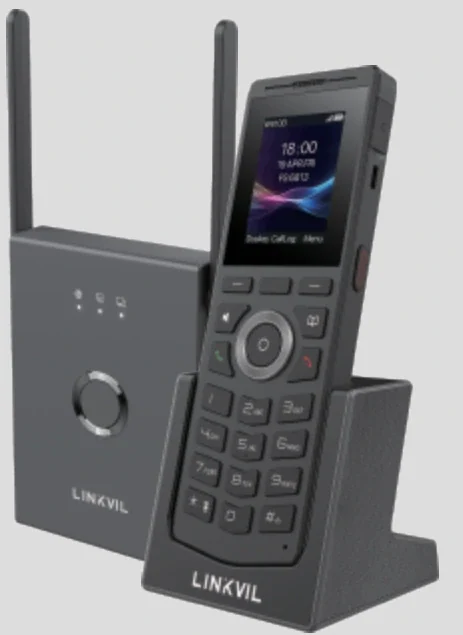
- Single-cell DECT - a W710D base takes up to 10 W610D handsets and 10 simultaneous calls, with radio coverage stated as 50 m indoors and 300 m outdoors. The base holds a directory of 1000 contacts and a 20000-entry call log, supports SRTP, SIPS and TLS, and takes PoE.
- Multi-cell DECT - W710H base stations carry up to 30 handsets each and 300 handsets across a system, with 16 simultaneous calls per base and 200 across the system. Coverage is stated as 100 m indoors and 700 m outdoors in the US figures, 60 m and 350 m in the EU figures, with seamless roaming between cells.
- Wi-Fi handsets - the W610W, W611W and W620W register over the site's Wi-Fi, with dual-band 2.4G and 5G, Wi-Fi 6 on the W611W and W620W, and no base station of their own.
Desk phones remain a fourth option, and the least fashionable one - but a fixed position has power and a cable, which is still the most reliable thing in the building.
The numbers that decide coverage — what should you know?
| Device | Capacity | Coverage | Battery |
|---|---|---|---|
| W710D base (single cell) | 10 handsets, 10 simultaneous calls | 50 m indoors, 300 m outdoors | PoE for the base |
| W710H base (multi-cell) | 30 handsets and 16 calls per base; 300 handsets and 200 calls per system | 100 m indoors, 700 m outdoors (US figures) | PoE for the base |
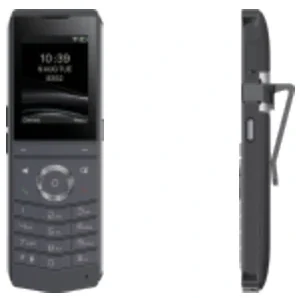
| W610D handset | 16 DSS keys plus a side key; six-party local conferencing | DECT bands including America, Europe, Japan, Taiwan and Brazil | Up to 8 h talk, 160 h standby |
| W611W handset | 16 DSS keys and a PTT key; IP67 | Wi-Fi 6 dual band, with 802.11k/v/r roaming | 1900 mAh, up to 9 h talk, 200 h standby |
| W620W handset | 16 DSS keys, one programmable and one PTT; six-party conferencing | Wi-Fi 6 dual band with seamless roaming | 3000 mAh, up to 13 h talk, 240 h standby |
Two figures deserve emphasis. First, the multi-cell DECT system is designed to scale: 16 simultaneous calls per base, 200 across the system, 300 handsets. Second, battery life in the Wi-Fi handset range varies by more than a shift - 8 or 9 hours of talk time against 13 - which matters if the device is used for long calls rather than occasional ones.
DECT or Wi-Fi: the real trade — what should you know?
DECT runs in its own licensed band, so its coverage does not change when the office Wi-Fi changes. That is an advantage in industrial buildings and hospitals, where Wi-Fi may be tuned for data, and where interference is a fact of life. The cost is a base station or several, plus the roaming design between them.
Wi-Fi handsets ride on infrastructure that already exists. Where a site has good coverage everywhere, a Wi-Fi handset needs no new cabling, no base, and no radio plan beyond the roaming settings. The W611W adds 802.11k/v/r roaming and WPA or WPA2-PSK and 802.1X EAP security, and its IP67 rating makes it the one to choose in wet or dusty areas - the W610D's DECT handsets carry a 1.8 m drop rating and vibration alert, but the IP67 claim belongs to the W611W.
A practical hybrid is common: DECT for staff who roam a building all day, Wi-Fi handsets for staff who roam a campus, and desk phones everywhere a person actually sits. The handsets do not need to be the same family; both register as SIP extensions on the same PBX.
When a desk phone still wins — what should you know?
Key count and line count are the two reasons to stay at a desk. A handset with 16 DSS keys is a lot of programmable buttons; a desk phone can carry far more.
- X3U: six SIP lines, a 2.8-inch colour screen, dual gigabit ports and PoE - the standard desk.
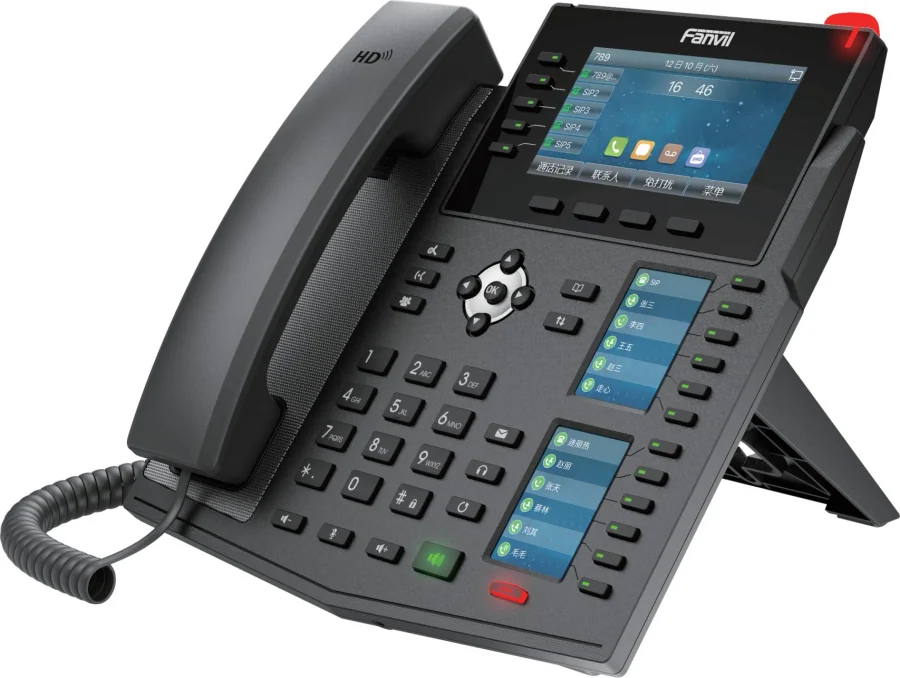
- X6U: twenty SIP lines, a 4.3-inch main screen with two 2.4-inch side screens, 60 DSS keys and five LED line keys - supervisor and busy-lamp duty.
- X210i: the paging console, with 20 SIP lines, 106 DSS keys and a gooseneck microphone, sitting where a fixed operator position is part of the job.
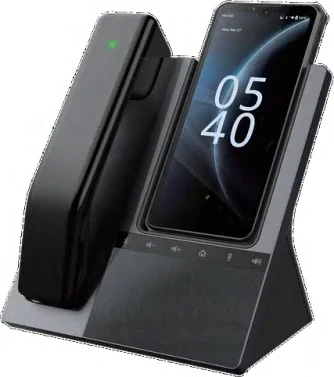
- V67: a 7-inch Android touch screen with 20 SIP lines, up to 116 DSS keys and a built-in camera, for positions that also need video.
If the role involves holding, transferring and watching colleagues' lines, a desk phone with side screens will always beat a handset, because the operator needs to see the state of the system rather than remember it.
One more option: radios — what should you know?
Where security or engineering staff already carry two-way radios, the W712 gateway connects one analog or DMR II radio to one SIP call and allows group calls between radios and SIP phones, with UHF coverage in the 400 to 470 MHz band and call recording on USB or a TF card. It is not a replacement for a handset, but it removes the excuse that the radio users are out of reach of the phone system.
Choosing in one pass
- Count the positions that move, and the distance they cover.
- Match the coverage model: single-cell DECT for a small building, multi-cell DECT for a large one, Wi-Fi handsets where the network is already good everywhere.
- Check the battery figures against a real shift, not against a datasheet best case.
- Put desk phones where people sit and where key count matters, and give the operator position a console.
- Register everything as a SIP extension, and let the PBX's own features - ring groups, transfer, voicemail - carry across handset, desk phone and console alike.