Voice engineering
Codecs explained: G.711, G.729, G.722 and G.722.2
On this page
- The five names on the media page — what should you know?
- Narrowband and wideband, in plain terms — what should you know?
- Where each one earns its place — what should you know?
- Recording supports two of the four — what should you know?
- The voicemail file name tells you the codec — what should you know?
- Codecs on the endpoints themselves
The five names on the media page — what should you know?
The PBX media configuration lists five codecs, printed in the manual as G.729A/20, G.711U/20, G.711A/20, G.722.2/20 and G.722/20. They fall into two groups. G.711 and G.729 are narrowband codecs; G.722 and G.722.2 are wideband. That distinction - not the compression ratio - is what a buyer actually notices on a call.
Two of them also have a hard role outside voice. G.711 is the codec that fax pass-through runs on, which is why the fax section of the manual is explicit that pass-through requires the codec to be set to G.711U/20 or G.711A/20 and nothing else.
Narrowband and wideband, in plain terms — what should you know?
- G.711 (U-law and A-law) - the reference narrowband codec. Every endpoint in this range supports it, it is the fallback when nothing else negotiates, and it is the required mode for analog-line fax. It is also the default choice when a prompt has to be recorded from an IP extension: the manual asks for PCMU or PCMA.
- G.729A - the compressed narrowband option. The manual recommends G.729 for IP phones in its registration guidance, and it is one of the two codecs the PBX can record.
- G.722 - wideband. The desk phone families in this range state wideband G.722 and Opus across the V, X, H and XU series, and the DECT and Wi-Fi handsets state G.722 and Opus as well.
- G.722.2 - the compressed wideband option, present on the PBX media page and useful where bandwidth is constrained but you still want the wider band.
Where each one earns its place — what should you know?
| Codec | Band | Use it when |
|---|---|---|
| G.711U / G.711A | Narrowband | Fax pass-through, prompt recording, and as the compatibility floor for any device from another vendor |
| G.729A | Narrowband | Recommended by the manual for IP phones; also one of the two recording codecs |
| G.722 | Wideband | Open-plan offices and meeting rooms, where the listener's ear does the work of separating voices |
| G.722.2 | Wideband | Wideband audio over a constrained link |
One practical note: a codec chain is only as good as its weakest link. If a call passes through a trunk that only offers narrowband, forcing G.722 on the local side buys nothing - the PBX will negotiate down. Configure a sensible order (wideband first where both ends support it, then the narrowband pair) and let negotiation do its job.
Recording supports two of the four — what should you know?
This is a constraint worth designing around: recording on this platform runs in G.711 and G.729 only. A site that wants recordings does not get a wideband recording, even if the live call negotiated G.722. If call recording is a compliance requirement, that decision sits above the codec choice, and the recording architecture matters more: the OM20G and OM50G record locally to their own storage as well as to a server, while the OM80E, OM200G and OM1000-UC record to a recording server only, with the server address configured on the PBX and port 1311 as the default.
The voicemail file name tells you the codec — what should you know?
Voicemail messages are stored with an extension that follows the codec in use, which is a quick way to diagnose a mismatch reported by a user who says a message will not play:
| Codec | Voicemail file |
|---|---|
| G.711 u-law | .pcm |
| G.711 a-law | .pcma |
| G.729 | .dat |
| G.722 | .g722 |
| G.722.2 | .g722B |
Messages are retrieved by dialling *98 from the extension, and once heard the file is renamed with an oldvm_ prefix. Message forwarding to a mailbox is available where the mail server configuration allows it.
Codecs on the endpoints themselves
The PBX media page is only half the list; the endpoints decide what can actually be negotiated.
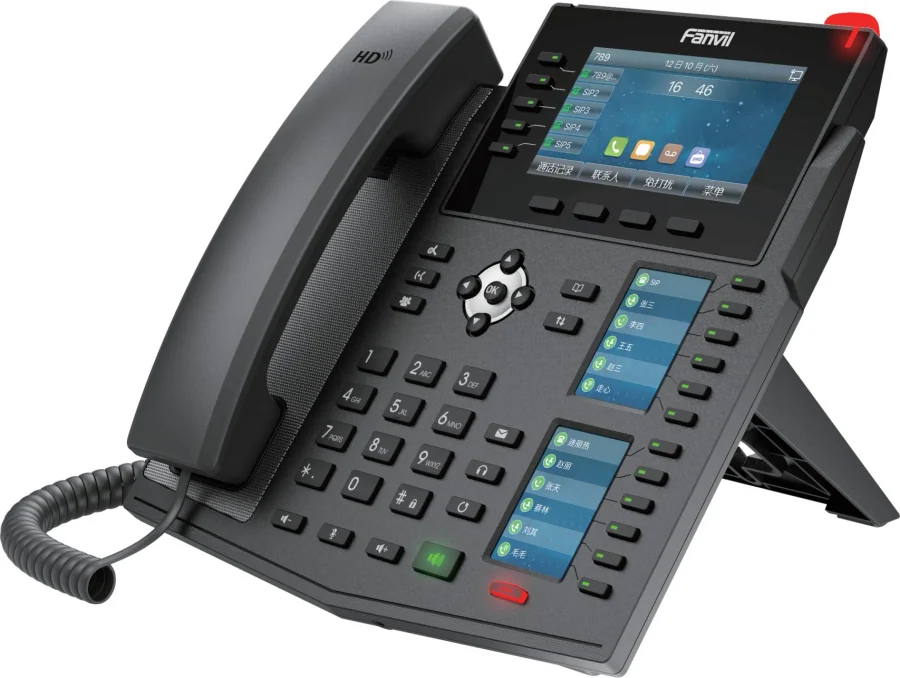
- Desk phones in the V, X and XU series: HD audio with wideband G.722 and Opus; several models also carry a fuller narrowband list on their comparison tables, including G.711, G.729A, iLBC and G.726.
- Hotel and care-phone families: premium HD audio with G.722 and Opus; the X305 big-button phone is specified the same way.
- DECT and Wi-Fi handsets: G.722 and Opus on the base and handset families, with SRTP, SIPS and TLS on the DECT bases.
- SIP speakers and gateways: G.722 and Opus, with the A212 stating sampling up to 44.1 kHz and offline timed broadcast.
For a mixed site the safe configuration is a short list - wideband first, G.711 next, G.729 as the compressed fallback. Leave DTMF on RFC2833, which is the default, and make sure the DTMF mode matches on both ends; a mismatch there breaks IVR menus long before codec choice becomes audible.