Healthcare
Care home device ratios: call points per bed
On this page
- Four ratios, four denominators — what should you know?
- The two published plans, side by side — what should you know?
- Where the ratios change — what should you know?
- Pendants and buttons: the third layer — what should you know?
- The console is the ceiling — what should you know?
- A worksheet that ends the argument
Four ratios, four denominators — what should you know?
Care home equipment lists go wrong when one ratio is applied to everything. The bedside station, the bathroom pull cord, the corridor light and the caregiver's handset do not share a denominator, and the printed plans in the care material show the divergence deliberately. Learn the four ratios and the count stops being a source of argument:
- Bedside station: one per bed position. Count beds, not rooms.
- Bathroom call point: one per bedroom. Count bedrooms, which is not the same as beds the moment a room has two.
- Corridor light: one per room, above the door, so staff walking past can read the call without entering.
- Portable handset: per caregiver on shift, not per bed. The plans propose 15 to 20 units against a care team of 15 plus the registered nurse.
The two published plans, side by side — what should you know?
| Item | 50-bed clinic | 70-bed nursing home | Counted per |
|---|---|---|---|
| Rooms | 15 (ten four-bed and five two-bed) | 40 (ten single and 60 beds in two-bed rooms) | Room schedule |
| Beds | 50 | 70 | Bed position |
| Bedside stations | 50 | 70 | Bed |
| Door-side stations | 15 | Not in the printed list | Room, at the door |
| Bathroom pull cords | 15 | 70 | Bedroom |
| Corridor lights | 15 | 40 | Room |
| Corridor displays | 2 | 4 | Floor, in public corridors |
| Portable handsets | 15 to 20 | 15 to 20 | Care team on shift |
| Nurse console | 1 | 1 | The ward or the whole home |
The clinic plan is the clearer illustration of why the numbers differ. Fifty beds sit in fifteen rooms, so the bedside station count is 50 while the pull cord and the corridor light are 15 each. The nursing home has an extra division: 70 beds in 40 rooms, so the pull cord count follows the bedroom (70) while the corridor light follows the room (40).
Where the ratios change — what should you know?
- Bed mix. A home that converts a two-bed room to a single raises the pull-cord-to-bed ratio without changing the corridor-light count. This is the most common reason two similar homes get different lists.
- Door-side positions. The clinic plan fits one per room for staff emergency and code blue calls raised as staff enter or leave. A home may fit them only on rooms where staff routinely move in and out, or on all of them - it is a decision, not a formula.
- Corridor displays. One per floor is the printed proposal, and it is optional. A display carries up to 30 prioritised messages on a 128x32 dot-matrix panel and shows the room and the call type to everyone in the corridor, so a single-bedroom wing may not need one.
- Assisted bathrooms. A shared assisted bathroom is a call point on its own, not a multiple of a bedroom count.
Pendants and buttons: the third layer — what should you know?
Between the fixed positions and the handsets sit the wearable and pull-cord buttons, and their host decides how many you can have:
- KT10 and KT20 - wireless buttons, self-powered with no battery, 433 MHz, working range 6 to 25 m. They connect to the bedside station series and to the X305 big-button phone; up to 10 wireless buttons can be hosted by either.
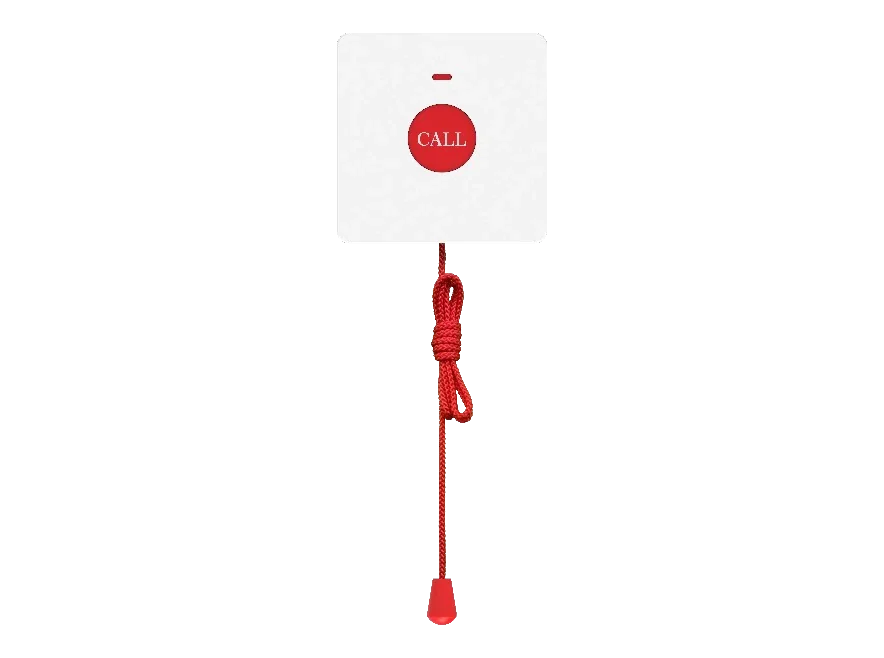
- KT30 - the wireless bathroom pull cord: IP65, 433 MHz, 6 to 25 m, battery inside.
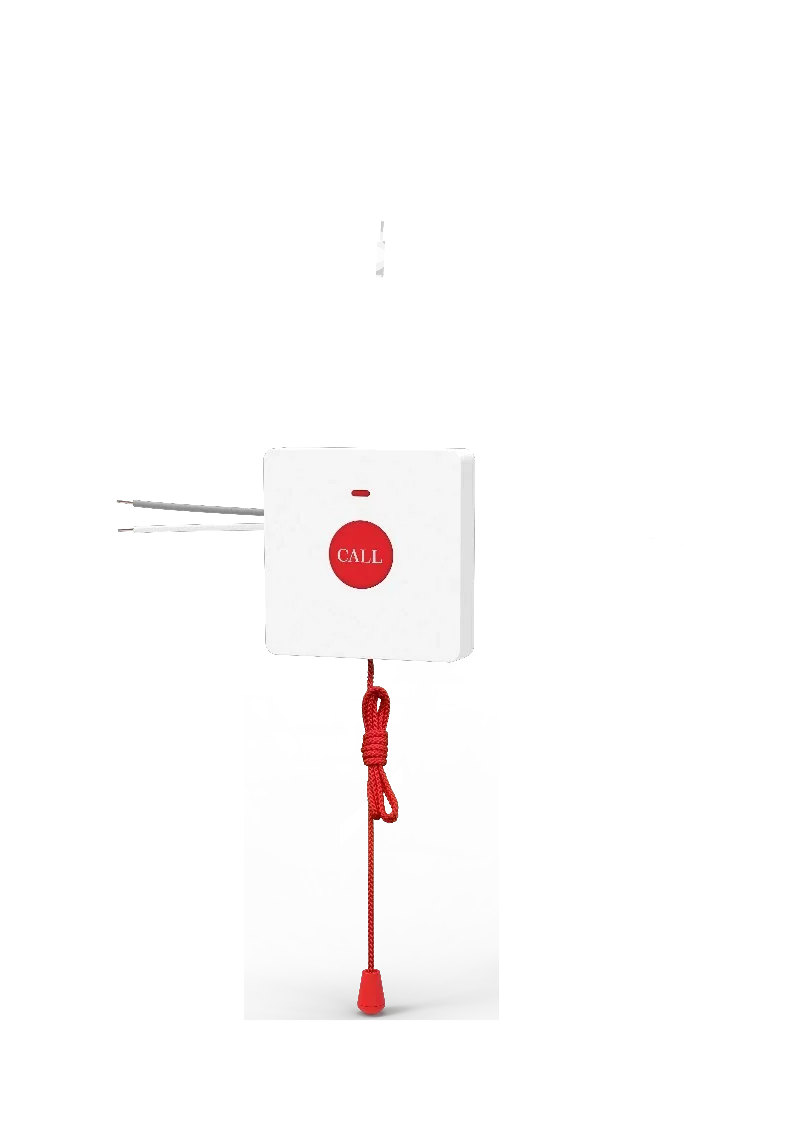
- KT31 - the wired bathroom pull cord: IP44, a 2 m cord, and no power of its own; it works with the bedside station series.
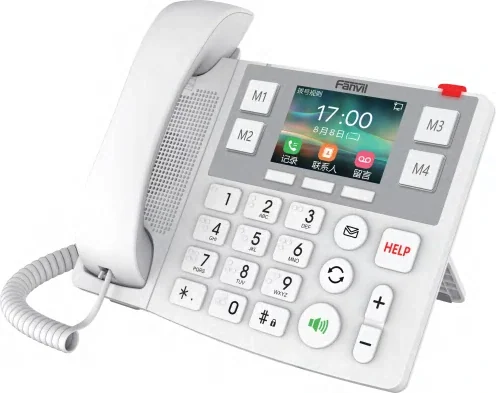
- X305 - the big-button room phone with a HELP button, four buttons for frequent contacts, Braille digit keys, and support for up to 10 KT10 wireless buttons. It is the device that covers a resident who is mobile but not a caregiver.
The console is the ceiling — what should you know?
Every fixed position above is a device on a console, and the care guide states that up to 100 devices can be connected to one nurse console. That is the number to size against, not the bed count. The 50-bed clinic plan puts 65 ward stations - 50 bedside and 15 door-side - plus 15 pull cords and two displays on one console, which is comfortably inside the limit. A larger home should count devices per console the same way and add a second console rather than assume the wing figure scales.
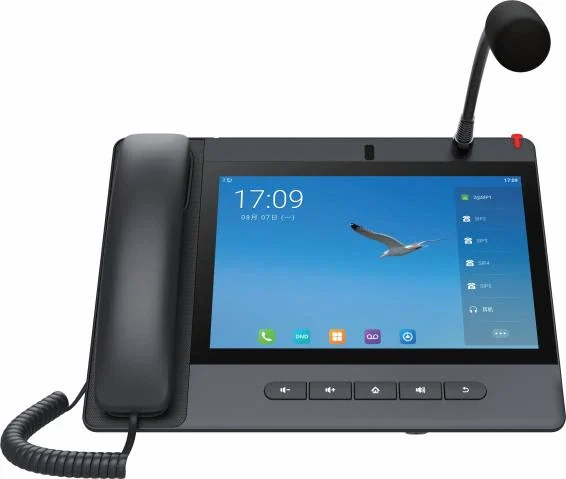
The console's own capacity is published too: 20 SIP lines, up to 116 DSS keys, a 10.1-inch touch screen, and call and attendance logs that can be exported. It also pushes call status and location to the corridor display, which is why the display count belongs in the same table as the stations.
A worksheet that ends the argument
- Count beds. That is the bedside station count.
- Count bedrooms. That is the pull-cord count.
- Count rooms. That is the corridor-light count.
- Count floors. That is the display count, and it is optional.
- Count caregivers on the busiest shift, then add the registered nurse. That is the handset count, and the plans put it at 15 to 20 for a team of 15 plus the RN.
- Add up every device that lands on a console and check it against 100; if it exceeds that, add a console.
- Count mobile residents separately, and cover them with self-powered pendants on the stations and the big-button phones rather than with more fixed positions.
Send us those seven numbers and the station list, the pull-cord mix and the console count follow - with the wireless or wired choice made on distance and power rather than on preference.