Intercom
Elevator intercom: travel cable and power
On this page
- Six positions, not one — what should you know?
- The travelling cable decides the design — what should you know?
- Where no spare core exists — what should you know?
- The power question — what should you know?
- Keep floor access separate — what should you know?
- The answering side is ordinary telephony
- What to survey
Six positions, not one — what should you know?
An elevator intercom is judged by one question: if the lift stops between floors, can the person inside speak to someone who can act - and does the equipment still have power when it matters. Designing for that starts by counting positions rather than devices. The solution material names a six-party arrangement for a 2-wire or 4-wire IP elevator intercom gateway:
- The car - the one position a passenger can reach.
- The car top - where a technician works with the doors open.
- The pit - the position nobody plans for until a surveyor asks.
- The machine room - usually where the gateway, the power and the network land.
- The management office - the first answering position in most buildings.
- The monitoring centre - the answering position when the building has one, or the desk that covers it out of hours.
Not every position needs a full station, but every position has to be able to reach a person who can act. That list is what a survey should be built around, and it is also the list a lift code tends to have an opinion about: which positions must be able to raise a call varies by country, so the applicable local code has to be read before the equipment is fixed.
The travelling cable decides the design — what should you know?
The cable that runs from the machine room to the car was sized for the lift, not for the network. Two or four spare cores is a design; none is a different design; and the difference has to be discovered at survey rather than during commissioning.
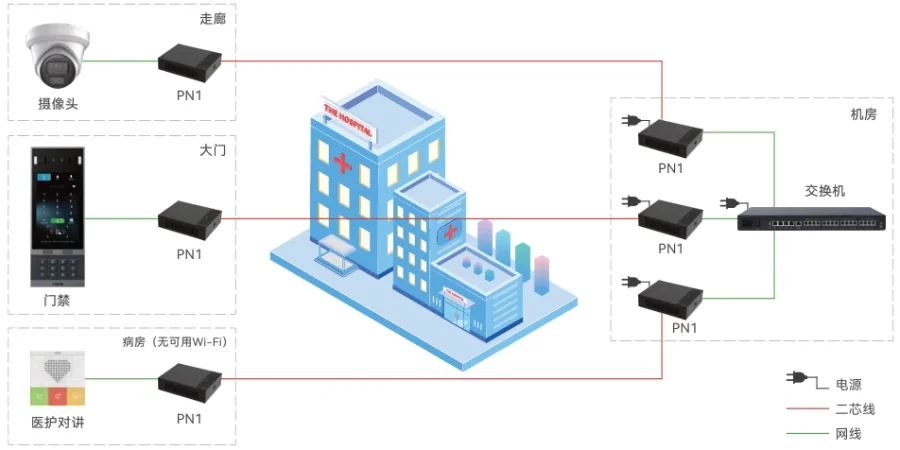
Where spare cores exist, the documented route is the 2-wire or 4-wire technique: network and power over the cores that are already there, with no new travelling cable and no new festoon.
| Device | What it carries | Published limits |
|---|---|---|
| PN1 converter | Network and power over a two-core pair; extends PoE wiring over 2-wire | Up to 1600 m for the network function without power; supplied locally at AC 100-240 V |
| PN8 switch | Two-wire network and power for a group of devices | Up to 8 two-wire devices; maximum connection distance 300 m for network plus power; built-in AC 100-240 V supply |
| PN24 switch | Two-wire network and power at a riser or cabinet | Up to 24 two-wire devices; 300 m; standard 1U chassis |
Read those two distances together, because they are the trap. The long figure - 1600 m - is stated for the network function without power. As soon as power travels with the signal, the working figure is 300 m. A design that quotes the first number while powering a device from the far end has not understood the table.
Where no spare core exists — what should you know?
If the travelling cable has no spare pair, the honest options are narrower, and the right move is to change the design rather than the claim:
- Put a station only where the existing cabling can reach, and give the car position its own short local run if the lift contractor can provide one.
- Use a wireless link only where the material actually documents one for that purpose, and treat the lift shaft as the hostile radio environment it is.
- Or accept a lift-contractor solution and keep the telephone system out of it - which is a legitimate answer, and better than an intercom that works on the bench and not in the shaft.
The power question — what should you know?
This is the part of an elevator intercom that has least to do with telephony. Three points to settle:
- Where the gateway is powered. The converters and switches in this range carry their own AC 100-240 V supplies, so the natural place for them is the machine room, where a supply and a cabinet usually already exist.
- What happens when the building supply fails. The materials do not state battery or standby figures for the intercom devices, so the standby arrangement is a site decision - it is confirmed on the quotation and designed with the building's own emergency supply, not assumed from a datasheet.
- Which side of the travelling cable carries power. Car-side devices fed from the machine room depend on the cores; car-side devices fed locally depend on the lift's own circuit. Both are legitimate; mixing them by accident is not.
Keep floor access separate — what should you know?
Lift control and lift emergency calling are two functions, and conflating them makes both harder to certify. Where the building restricts floors, that is an access-control function: the EC20 IP elevator access controller drives 64 outputs expandable to 128 over RS485 and Wiegand 26/34, is configured over web software, works with the door terminals over HTTP commands, can call the lift to the first floor ahead of arrival and can restrict visitors to designated floors. Keep it out of the emergency call chain.
The answering side is ordinary telephony
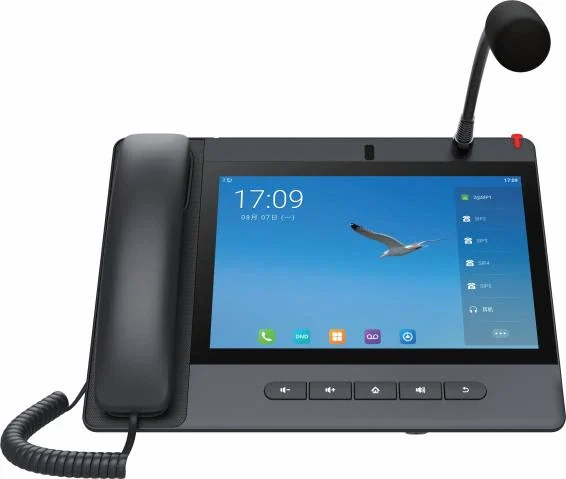
What makes the chain testable is that the answering end is a normal extension. A call from the car rings a manned position - an A320i console with 20 SIP lines, up to 116 DSS keys and up to 100 connected devices, or a console with an RS-485 interface for building signals - and the PBX behind it publishes 24 to 1000 SIP trunks depending on the model.
- Bind the lift extension to a ring group so the call reaches more than one desk, and let the queue hold it when everyone is busy.
- Give the lift its own number block, and write the answering order down: who answers in hours, and who answers at 03:00.
- Test it from the car, with the doors closed, with the building's normal power, and then again with the standby supply in use.
What to survey
- Number of lifts and how many positions each one needs, from the six-party list.
- Spare cores in each travelling cable, and whether power can travel on them.
- Distance from the machine room to the car, measured rather than estimated.
- Where the gateway and its supply will live, and whether that cabinet has room and a network drop.
- Whether the building already has a floor-access controller, and who maintains it.
- Which local code applies, and which of the six positions it requires to be able to call.
Bring those six answers and the design follows; leave one out and the project discovers it in the shaft.